
Related Expert Tools
More precision tools in the same niche.
Nether Portal Calculator
The Nether Portal Calculator works out whether two Overworld portals will link to the same Nether-side exit, using the game's real 8:1 coordinate scale and 16-block portal search radius rather than a plain distance guess. It shows each portal's computed Nether coordinates and how far apart they'd need to be to guarantee separate exits. Use it before building a Nether highway instead of finding out two hubs accidentally share a portal.
Minecraft Circle Generator
The Minecraft Circle Generator works out exactly which blocks to place to build a pixel-perfect circle of a given diameter, in either outline or filled mode. It renders a visual block-by-block grid you can follow directly in-game and counts the total blocks needed. Use it to plan towers, wells, fountains, and round floors without guessing block placement by eye.
Minecraft End Portal Finder
The Minecraft End Portal Finder triangulates a stronghold's coordinates from two Eye of Ender throws, using each throw's location and F3 facing angle to work out exactly where the two lines cross. It also converts the result to Nether coordinates so you can travel there roughly eight times faster. Use it instead of blind digging or wasting extra eyes on a third and fourth throw.
Pyramid Block Calculator Logic
Why a Pyramid's Block Count Isn't Base Times Height
The instinct to reach for base times height divided by three, the formula for a smooth continuous pyramid, is a common first move, and it's the wrong one for a Minecraft build. A Minecraft Forum thread on exactly this question shows a builder working through that same wrong turn before landing on the real answer: a stepped pyramid is a stack of flat square layers, and each one needs to be counted on its own.
This calculator works that count out directly from a single base side length, showing both the hollow and solid totals so you know exactly what a build costs before placing a single block.
Solid vs Hollow: A Fourfold Difference in Materials
Filling a pyramid's interior solid rather than leaving it hollow doesn't cost twice as much, it costs roughly four times as much at common base sizes, and that gap only widens as the base grows.
Base Side | Hollow Blocks | Solid Blocks | Ratio |
|---|---|---|---|
11 | 121 | 341 | ~2.8x |
21 | 441 | 1,771 | ~4.0x |
31 | 961 | 5,456 | ~5.7x |
Given that a solid build's cost scales with the square of the base size while hollow scales much closer to linearly, that gap keeps stretching further apart on bigger builds. As a result, planning a large solid pyramid without checking the numbers first is one of the fastest ways to run out of materials halfway up a build.
How the Layer-by-Layer Math Works
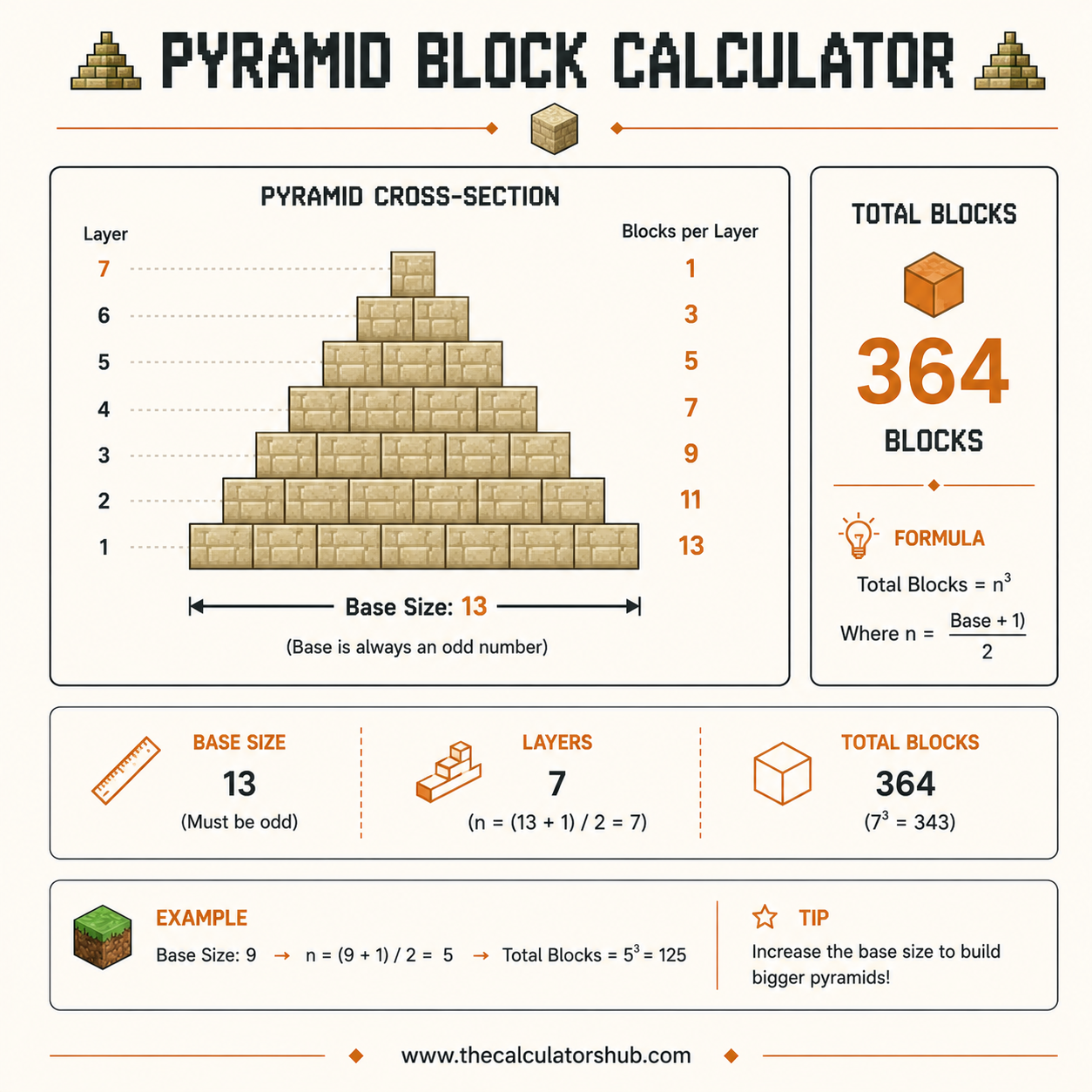
Each layer insets exactly 1 block on every side compared to the one below it, so a base of 21 produces layers sized 21, 19, 17, all the way down to 1, always centered under the layer beneath. That inset pattern is what produces Minecraft's familiar 45 degree stepped slope, and it's also why the total block count comes out to a sum of squares rather than a single multiplication.
Odd vs Even Base: Point or Platform
An odd base size shrinks all the way down to a single center block, a true apex point, the same way an odd-diameter circle centers on one exact pixel. An even base size can't do that; it bottoms out at a 2x2 platform instead, since there's no single block that sits exactly in the middle of an even span. That said, neither is wrong, they just read very differently once built, and picking a base size without checking this first can mean a flat cap where you expected a sharp point.
The Sum-of-Squares Shortcut
Rather than adding up every individual layer by hand, the calculator applies a closed-form sum: for an odd base, the solid total is the sum of squares of the first several odd numbers, and for an even base, it's the sum of squares of the first several even numbers. Hollow totals follow the same pattern using each layer's perimeter instead of its full area. This is exactly the kind of grid-based math our Minecraft Circle Generator applies to circles, just extended into a third, vertical dimension.
How This Compares to the Real Great Pyramid
A standard Minecraft pyramid's 1-in-1-up stepping produces a 45 degree face slope. The Great Pyramid of Giza's actual slope runs closer to 51.5 degrees, noticeably steeper than the simple block-stepped model most builders use. One especially dedicated player documented in a survival replica build matched that real 51.5 degree slope at full scale, a project that reportedly used around 2.5 million blocks over more than a year of play, a useful reminder of just how much steeper and more expensive an authentic slope gets compared to this calculator's simplified stepping.
A Worked Build Example
Take a 21-block base, a common starting point since it produces a clean 11-layer pyramid with a true single-block apex. Hollow, that comes to 441 blocks; solid, 1,771. If you're stocking up beforehand, our Minecraft Stack Calculator works out exactly how many chests that hollow or solid total needs to haul to the build site.
The Most Common Pyramid Planning Mistake
The mistake I made on my first large pyramid build was going solid on a 31-block base without checking the numbers first, and watching it eat through 5,456 blocks total, more than five times the 961 blocks the same shape would have needed hollow. With that in mind, I now run the hollow total before committing to solid on anything past a 15 or 20-block base, since that gap only gets wider as the base grows. It also helps to confirm whether the base size is odd or even before starting, since redoing a lopsided apex after the fact means tearing out several finished layers.
Frequently Asked Questions

Muhammad Shahbaz Siddiqui
Founder, TheCalculatorsHub
How going solid on a 31-block base burned through five times the obsidian I actually needed
Committing a full shulker box of blackstone to a monument build two winters ago, I picked a 31-block base and decided solid would look more imposing than hollow. I didn't run the numbers first, I just started stacking layers downward from the widest ring and figured I had more than enough material stockpiled to finish.
Somewhere around layer six I was already down to my last stack, with ten layers still to go. Working the math backward afterward showed exactly why: a 31-block solid pyramid needs 5,456 blocks total, while the same base hollow only needs 961. According to the Minecraft Forum, that's exactly the trap new builders fall into, reaching for a simple volume estimate instead of realizing a stepped pyramid's material cost scales with the square of the base, not something closer to linear.
I finished the build hollow instead, and it looked just as imposing from outside, since nobody standing at the base could tell whether the inside was packed solid or empty. I now run both totals before starting anything bigger than a 15-block base, since the five-times difference at 31 blocks only gets worse the larger the pyramid gets.