
Related Expert Tools
More precision tools in the same niche.
Nether Portal Calculator
The Nether Portal Calculator works out whether two Overworld portals will link to the same Nether-side exit, using the game's real 8:1 coordinate scale and 16-block portal search radius rather than a plain distance guess. It shows each portal's computed Nether coordinates and how far apart they'd need to be to guarantee separate exits. Use it before building a Nether highway instead of finding out two hubs accidentally share a portal.
Minecraft Circle Generator
The Minecraft Circle Generator works out exactly which blocks to place to build a pixel-perfect circle of a given diameter, in either outline or filled mode. It renders a visual block-by-block grid you can follow directly in-game and counts the total blocks needed. Use it to plan towers, wells, fountains, and round floors without guessing block placement by eye.
Pyramid Block Calculator
The Pyramid Block Calculator works out exactly how many blocks a stepped Minecraft pyramid needs, in either hollow or solid fill, from a single base side length. It shows the height in layers, whether that base size ends in a true apex point or a flat platform, and how much more a solid version costs versus hollow. Use it before committing to a build instead of running out of materials halfway up.
Minecraft End Portal Finder Logic
Why You Need Two Throws to Find a Stronghold
Throwing a single Eye of Ender only shows you a direction, never a distance, so it's impossible to work out where the stronghold sits from one throw alone. According to the Minecraft Wiki, every world generates 128 strongholds spread across eight rings around the origin point, and each eye you throw flies in a straight line toward the nearest one.
This calculator solves that by taking two throws from different spots and figuring out exactly where their two lines cross, the same triangulation approach speedrunners and casual players alike use to skip blind digging entirely. If you're also planning a base or a decorative build once you've dug in, our Minecraft Circle Generator handles the block-by-block layout for a round entrance or tower.
How Minecraft's F3 Facing Angle Works
Open the F3 debug screen and look for "Facing," a number between -180 and 180 that describes which way you're looking, not the compass bearing most players expect at first glance. According to the Minecraft Wiki's rotation page, this yaw value follows its own convention rather than standard compass degrees, which trips up players who assume 90 degrees always means east.
F3 Facing Angle | Direction | Movement |
|---|---|---|
0° | South | +Z |
90° | West | -X |
180° / -180° | North | -Z |
-90° | East | +X |
Read this number at the exact moment the eye leaves your hand, since facing even slightly off to one side a second before or after the throw records the wrong angle and throws the whole calculation off.
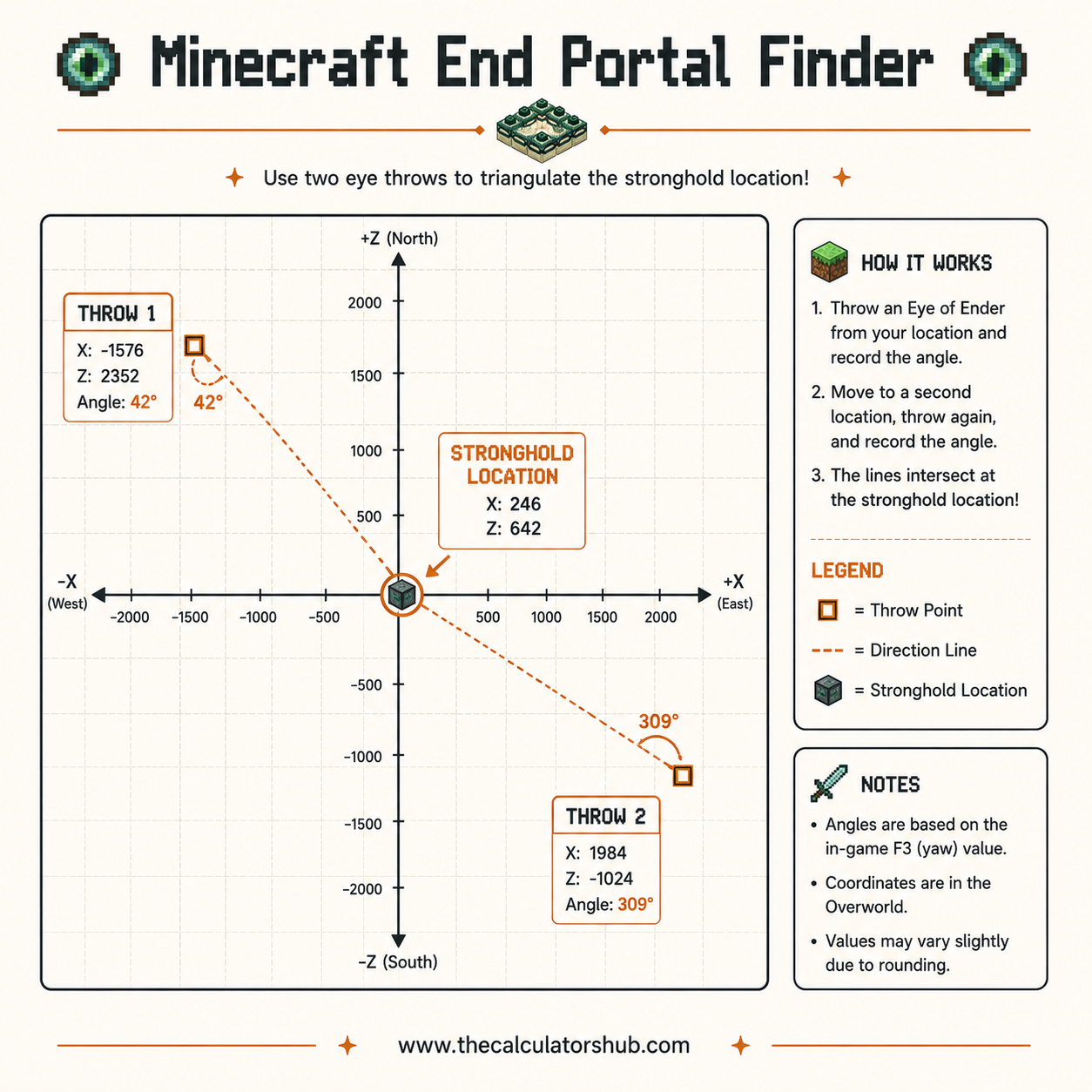
From Two Throws to One Coordinate
Each throw becomes a line on paper: a starting point, your coordinates, and a direction, taken from the facing angle. The calculator converts both throws into these lines and solves for the single point where they intersect, treating your coordinates and angles as exact inputs rather than guessing at anything in between.
If your two throws happen to point in parallel or near-parallel directions, the lines never cross and no solution exists, which is why the calculator flags that case outright instead of returning a meaningless coordinate. Given that even a fraction of a degree of misreading can shift the answer, precision on the angle matters more than precision on the coordinates.
Why Eyes of Ender Sometimes Break Mid-Throw
Each Eye of Ender has roughly a 20% chance of shattering in flight instead of landing as a recoverable item, so a triangulation session can quietly eat through more eyes than expected. As a result, it's worth crafting a handful of spares, six or eight beyond the two you strictly need, before you start walking out to your throw spots.
This also explains why some players report "losing" an eye with no visible flight path: it broke on impact rather than staying on the ground to be picked back up.
Why Your First Estimate Might Be Off
A first triangulation from two throws commonly lands 50 to 100 blocks away from the real stronghold, sometimes more if the stronghold is far from your throw spots. That said, this isn't a flaw in the math, it's a direct result of how far a small angle error stretches once the line is extended a long way. Serious speedrunning tools like Ninjabrain Bot go further still, treating each angle reading as slightly uncertain and combining several throws statistically rather than trusting one intersection outright.
You don't need software that sophisticated to get a good result. Walking to your first estimate and throwing a third eye from there, much closer to the actual stronghold, shrinks the same angular error down to a far smaller physical distance.
Nether Travel: Divide By Eight
Distances in the Nether are scaled down eight times compared to the Overworld, so crossing to the Nether and walking the divided-by-eight distance between your throw spots, or toward your stronghold estimate, gets you there roughly eight times faster than walking the Overworld route directly. The calculator works this conversion out automatically alongside the main coordinate result.
A Worked Triangulation Example
Say you throw your first eye at X:100, Z:0 and the F3 screen reads a Facing angle of 45 degrees. You then walk 400 blocks and throw a second eye at X:100, Z:400, reading a Facing angle of -60 degrees. Feeding both throws into the calculator produces a single intersection point, the estimated stronghold location, along with the straight-line distance between your two throw spots so you can judge whether that spread was wide enough to trust the result.
Triangulating game coordinates like this is a similar kind of precise number-crunching to what our KD Calculator does for players tracking performance stats between matches.
The Most Common Triangulation Mistake
The mistake I see most often is throwing both eyes from spots that are too close together, sometimes barely 20 or 30 blocks apart, which turns a tiny half-degree reading error into a stronghold estimate that's off by hundreds of blocks once the lines are extended out. With that in mind, I'd always walk at least 200 blocks between throws before taking the second reading, since that spacing shrinks the angular error enough to land your dig within a chunk or two of the real staircase. It also helps to re-throw a third eye once you're standing near the first estimate, since that closer-range throw tightens the intersection dramatically compared to relying on the original wide-spread pair alone.
Frequently Asked Questions

Muhammad Shahbaz Siddiqui
Founder, TheCalculatorsHub
How ignoring the 200-block rule cost me an evening of digging in the wrong spot
A speedrun-practice session back in June had me rushing my first triangulation, throwing both eyes from spots barely 25 blocks apart because I didn't want to waste time walking further out. The F3 screen gave me two facing angles, I ran the numbers, and started digging exactly where the lines crossed. Forty minutes of tunneling later, I'd hit nothing but stone.
Going back and redoing the throws properly, this time walking a full 250 blocks between them, gave me a completely different intersection point, over 300 blocks from my first attempt. According to the Eye of Ender page, the F3 facing angle only shows whole-degree precision on the overlay, and that small a rounding error stretches into a huge miss once the two throw points sit too close together. My first pair of throws hadn't been wrong exactly, they'd just been too close together for the angle error to stay small over distance.
The second triangulation put me within about 40 blocks of the actual staircase, close enough that a single follow-up eye confirmed the direction and I was standing at the portal room minutes later. I now treat 200-block spacing as a hard rule rather than a suggestion, since speedrunning triangulation tools exist specifically because this kind of angle error is the single biggest source of wasted digging time.