
Related Expert Tools
More precision tools in the same niche.
Minecraft Circle Generator
The Minecraft Circle Generator works out exactly which blocks to place to build a pixel-perfect circle of a given diameter, in either outline or filled mode. It renders a visual block-by-block grid you can follow directly in-game and counts the total blocks needed. Use it to plan towers, wells, fountains, and round floors without guessing block placement by eye.
Minecraft End Portal Finder
The Minecraft End Portal Finder triangulates a stronghold's coordinates from two Eye of Ender throws, using each throw's location and F3 facing angle to work out exactly where the two lines cross. It also converts the result to Nether coordinates so you can travel there roughly eight times faster. Use it instead of blind digging or wasting extra eyes on a third and fourth throw.
Pyramid Block Calculator
The Pyramid Block Calculator works out exactly how many blocks a stepped Minecraft pyramid needs, in either hollow or solid fill, from a single base side length. It shows the height in layers, whether that base size ends in a true apex point or a flat platform, and how much more a solid version costs versus hollow. Use it before committing to a build instead of running out of materials halfway up.
Nether Portal Calculator Logic
Why Two Portals Sometimes Link and Sometimes Don't
Building a second Nether portal near an existing one doesn't automatically connect them, and the reverse is also true, two portals that look far apart on the Overworld map can end up sharing the same Nether-side exit. According to the Minecraft Wiki, whether a portal links to an existing one or generates a fresh one comes down to a specific search radius around a coordinate calculated with the game's 8:1 scale, not just how the two locations look on a map.
This calculator works that comparison out directly: enter both portals' Overworld coordinates and it tells you whether they'll link, without guessing at the distance by eye.
The 8:1 Coordinate Scale, Explained
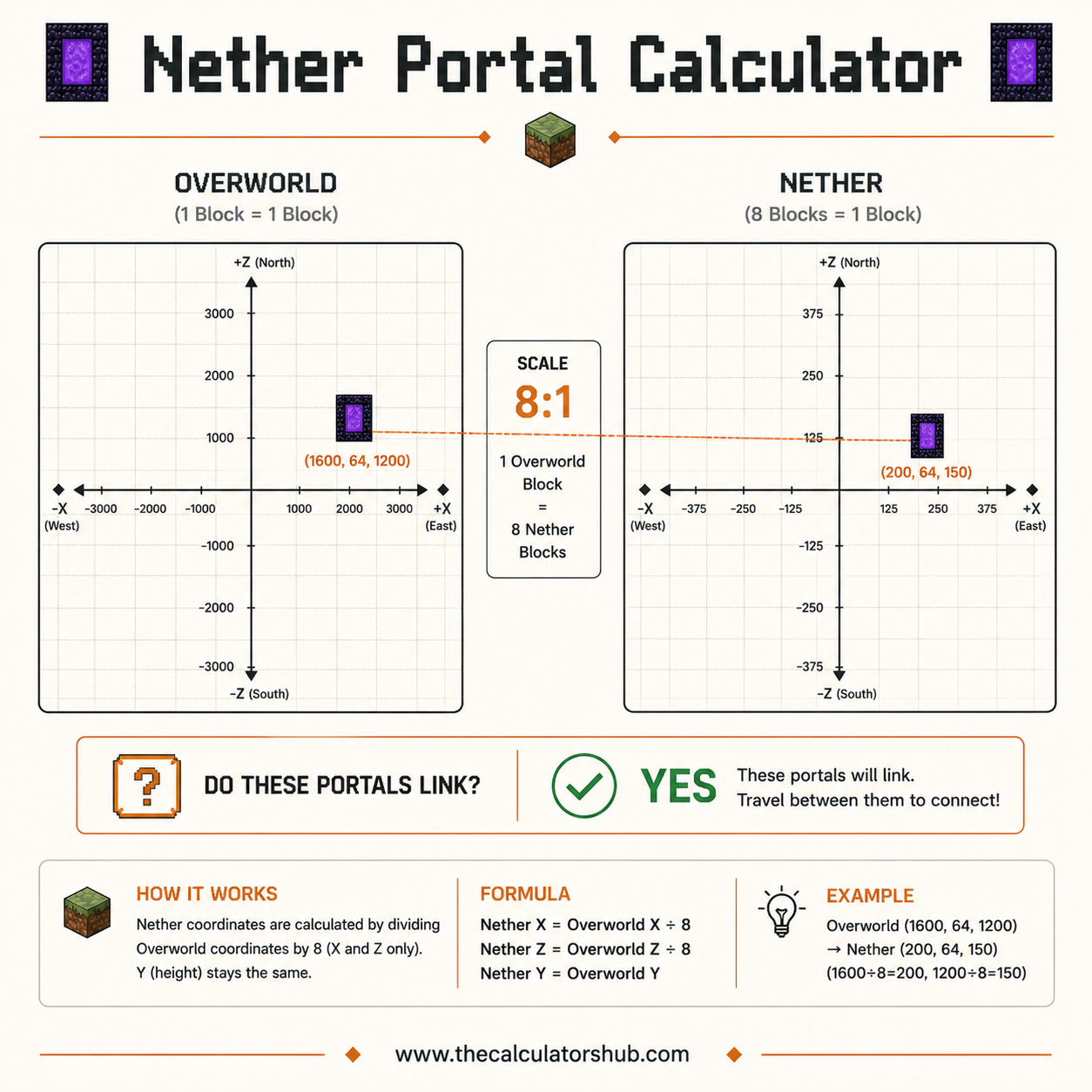
Every block you travel in the Nether covers 8 blocks of equivalent Overworld distance, which is why the Nether is the fast-travel shortcut experienced players build highways through. A portal's Overworld X and Z coordinates are divided by 8 and rounded down to figure out its target Nether position; the Y coordinate carries over unchanged.
Overworld Coordinate | Nether Coordinate |
|---|---|
X: 100, Z: 0 | X: 12, Z: 0 |
X: 400, Z: 800 | X: 50, Z: 100 |
X: 2000, Z: -500 | X: 250, Z: -63 |
The Search Radius That Actually Decides Linking
Once a target Nether coordinate is calculated, the game doesn't require an exact match to link two portals, it searches a radius around that point for anything already built. Per the portal search mechanics documented on the wiki, that radius is 16 blocks when searching the Nether side and 128 blocks when searching the Overworld side, figures that stay consistent with each other once you factor in the 8:1 scale.
That wasn't always true. Before a fix in version 1.16.2, the Overworld-to-Nether search mistakenly used a 128-block Nether-side radius instead of 16, letting portals link across distances far larger than intended. Given that older, un-rebuilt highways can still carry this quirk, unexpectedly long-distance linking on an old world isn't necessarily a bug in your build.
Spacing a Nether Highway Without Cross-Linking
Since the Nether-side search radius is 16 blocks, that scales back up to 128 Overworld blocks once you multiply by 8. Space hub portals along a highway more than 128 blocks apart and each one is guaranteed its own independent Nether exit. Closer than that, and two hubs risk quietly sharing a single portal. As a result, travelers can arrive at the wrong hub entirely with no obvious explanation for why.
What Happens When the Target Spot Is Blocked
If the ideal linking location in the Nether sits inside solid rock or a lava lake, the game doesn't simply fail. It looks for a clear 3x4 area with headroom within that same 16-block radius, falls back to a narrower 1x4 strip if nothing bigger is available, and as a last resort force-places a portal at the target anyway, clamped to a safe vertical band well away from bedrock and the build ceiling. This explains why a portal occasionally comes out somewhere unexpected rather than exactly where the math points.
Minimum and Maximum Portal Frame Sizes
A valid frame needs at minimum a 2x3 interior inside a 4x5 obsidian footprint, and can scale up to 23 by 23 at the largest. Corner blocks aren't functionally required, only the four straight edges need to be solid, though the game always includes corners when it generates a portal automatically. A bare minimum frame without corners takes 10 obsidian; a full frame with all 4 corners takes 14. That said, the Nether portal tutorial is worth a look before a large build, since sizing up toward the 23x23 maximum multiplies your obsidian cost fast.
A Worked Linking Example
Take a portal at Overworld X:0, Z:0 and a second one at X:100, Z:0. The first maps to Nether X:0, Z:0, and the second maps to Nether X:12, Z:0, a distance of 12 blocks, inside the 16-block radius. These two link to the same exit despite sitting a full 100 blocks apart on the Overworld map, which is exactly the kind of result that surprises builders expecting distance alone to decide it. If you're also planning the trip's obsidian and material haul, our Minecraft Stack Calculator works out how many chests that load needs.
The Most Common Nether Portal Mistake
The mistake I made building my first Nether highway was spacing hub portals 100 blocks apart along the route, assuming that was plenty of separation, and watching three of them quietly collapse into a single shared exit instead of each getting its own. With that in mind, I now treat 128 blocks as the real minimum spacing on any Overworld highway, not the smaller number that feels intuitively safe. It also helps to cross-check a hub's placement against a stronghold triangulation run on the same trip, since both problems come down to the same kind of coordinate math done carefully instead of eyeballed.
Frequently Asked Questions

Muhammad Shahbaz Siddiqui
Founder, TheCalculatorsHub
How three highway hubs I built 100 blocks apart quietly shared one Nether exit
Laying out a Nether highway with a server group last autumn, I spaced our first three hub portals 100 blocks apart along the Overworld route, reasoning that was generous room to keep them separate. The moment we tested all three, only one Nether-side portal existed. Stepping through any of the three Overworld hubs dropped us at the exact same spot in the Nether, not three distinct exits like we'd planned.
Checking the numbers afterward made the cause obvious. According to the Minecraft Wiki, portals link whenever their Nether-side coordinates, the Overworld position divided by 8, land within 16 blocks of each other. Our 100-block Overworld spacing scaled down to just 12.5 blocks in the Nether, comfortably inside that radius, so all three hubs had been destined to collapse into one shared portal from the moment we placed the first stake in the ground.
We tore out two of the three and rebuilt them more than 130 blocks apart instead, which finally gave each hub its own independent exit. I now run the Overworld distance against the 128-block safe-spacing threshold before placing a single obsidian block, since the intuitive "100 feels like plenty" instinct is exactly what got three hubs merged into one the first time.