
Related Expert Tools
More precision tools in the same niche.
Nether Portal Calculator
The Nether Portal Calculator works out whether two Overworld portals will link to the same Nether-side exit, using the game's real 8:1 coordinate scale and 16-block portal search radius rather than a plain distance guess. It shows each portal's computed Nether coordinates and how far apart they'd need to be to guarantee separate exits. Use it before building a Nether highway instead of finding out two hubs accidentally share a portal.
Minecraft Circle Generator
The Minecraft Circle Generator works out exactly which blocks to place to build a pixel-perfect circle of a given diameter, in either outline or filled mode. It renders a visual block-by-block grid you can follow directly in-game and counts the total blocks needed. Use it to plan towers, wells, fountains, and round floors without guessing block placement by eye.
Minecraft End Portal Finder
The Minecraft End Portal Finder triangulates a stronghold's coordinates from two Eye of Ender throws, using each throw's location and F3 facing angle to work out exactly where the two lines cross. It also converts the result to Nether coordinates so you can travel there roughly eight times faster. Use it instead of blind digging or wasting extra eyes on a third and fourth throw.
Minecraft Stack Calculator Logic
Why a Raw Item Count Doesn't Tell You What You Need
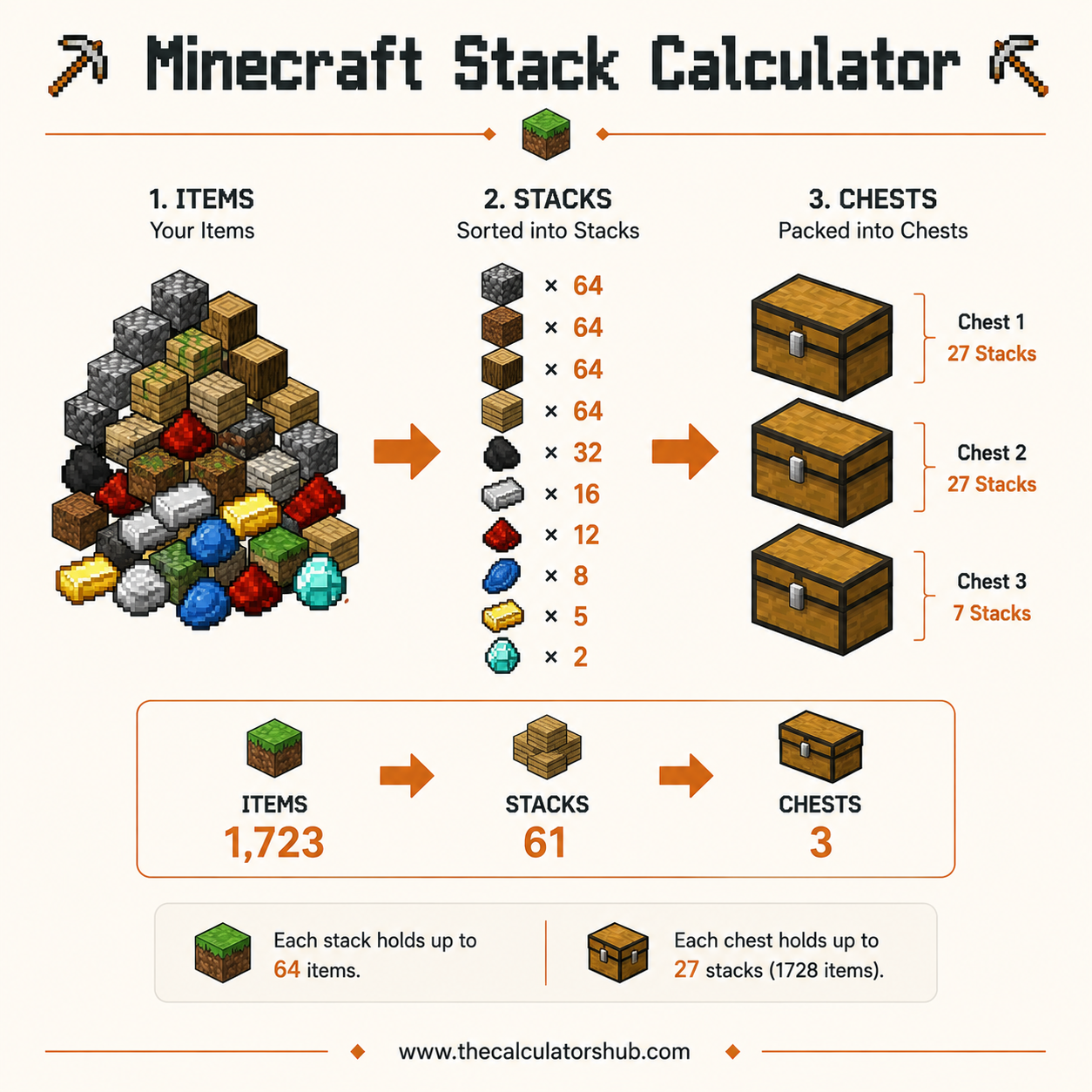
Seeing "1,000 cobblestone" in a chat message or a shopping list doesn't tell you how much inventory space, how many chests, or how many trips that actually costs you, since the answer depends entirely on how that item stacks. This calculator works that number out directly, converting a raw count into full stacks, leftover items, and the exact containers needed to store the whole quantity.
Getting this right matters more than it looks. According to the Minecraft Wiki, the vast majority of items stack to 64, but a meaningful subset break that rule entirely, and planning storage around the wrong assumption leaves you short on chests or hauling far more materials than your inventory can hold.
Not Everything Stacks the Same Way
Most blocks, food, and crafting materials stack to 64 per slot. A smaller group of items, ender pearls, snowballs, eggs, signs, honey bottles, banners, written books, armor stands, and empty buckets, cap out at 16 instead, largely because throwable items are limited on purpose to stop players carrying an overwhelming burst of throws in one stack. A third group, tools, weapons, armor, potions, minecarts, boats, and filled buckets, don't stack at all.
Stack Size | Typical Items | Slots for 100 Items |
|---|---|---|
64 | Cobblestone, wood, iron ingots, food | 2 slots |
16 | Ender pearls, signs, honey bottles | 7 slots |
1 | Tools, armor, potions, boats | 100 slots |
That third row is exactly why an unstackable item can quietly eat an entire chest, or several, that a stacking item of the same quantity would never come close to filling.
From Raw Count to Stacks and Leftover
The math itself is simple division: full stacks equal the item count divided by the stack size, rounded down, and the leftover is whatever remains after those full stacks are removed. A thousand cobblestone at a 64-stack size works out to 15 full stacks with 40 blocks left over in a sixteenth, partial stack. That leftover stack still occupies its own inventory slot even though it isn't full, which is easy to forget when you're mentally rounding down.
Turning Slots Into Chests, Shulkers, and Hoppers
Once you know how many slots a quantity needs, storage math follows directly from a handful of fixed container sizes. According to the Minecraft Wiki's chest page, a single chest holds 27 slots and a double chest holds 54, exactly twice as much. A shulker box also holds 27 slots, the same as a single chest, but survives being mined and can be carried in your inventory. A hopper, by contrast, holds only 5 slots. As a result, hoppers make poor long-term storage and are meant for sorting and moving items instead.
Given that a player's main inventory and hotbar together hold 36 general-purpose slots, any quantity needing more than that has to spill into a chest, an ender chest, or a shulker box before you can carry it all at once.
The Bundle Exception
Bundles break from this pattern entirely. Rather than holding a flat item count, a bundle holds 64 weighted "bundle-slots," and each item consumes 64 divided by its own stack size per unit. A 64-stack item like a stick costs 1 bundle-slot each, a 16-stack ender pearl costs 4, and a fully unstackable item like a sword fills the entire bundle by itself. Thirty-two sticks plus eight ender pearls fills a bundle exactly, since 32 times 1 plus 8 times 4 both add up to 32, for 64 total.
Shulker Boxes Can't Nest Inside Each Other
A common assumption is that stacking shulker boxes inside more shulker boxes multiplies your storage indefinitely, but the game blocks this outright. A shulker box that already contains items can't be placed inside another shulker box's inventory. That said, this cap only limits nesting, not how many separate shulker boxes you can line up side by side in one chest, so genuinely large hauls still expand outward into more boxes rather than nesting deeper.
A Worked Storage Example
Say you've mined 2,000 cobblestone on a stack size of 64. That works out to 31 full stacks with 16 left over, 32 total slots. Thirty-two slots comfortably clears a single 27-slot chest's capacity, so you'd need two chests, or one double chest with room to spare, to bring the whole haul home. If you're also triangulating a stronghold on the same trip, our Minecraft End Portal Finder handles that math, and our Minecraft Circle Generator can lay out the storage room itself once you're back.
The Most Common Stack Miscalculation
The mistake I run into most often is planning a supply trip around the default 64-stack assumption and forgetting that a handful of items break that rule entirely. I once packed for what I thought was 4 slots of ender pearls, expecting 256 total, only to find the 16-stack math meant those same 4 slots held just 64 pearls, a quarter of what I'd actually planned for a stronghold run. With that in mind, I always double-check an item's stack size before counting slots, especially for anything throwable or written, since assuming 64 across the board is the single most common way this math goes wrong.
Frequently Asked Questions

Muhammad Shahbaz Siddiqui
Founder, TheCalculatorsHub
How one wrong stack-size assumption left me two shulker boxes short on moving day
Packing up an entire base to relocate closer to a new spawn point last spring, I counted my storage room by eye and figured four double chests of assorted goods would cover the move. That guess was built entirely on 64-item stacks, since that's what almost everything in the room defaults to.
What I hadn't accounted for was a shelf of written books from a long-running library project and two stacks of empty buckets set aside for a dairy farm, both capped at 16 items per stack rather than 64. According to the Minecraft Wiki, that quarter-sized cap applies specifically to items considered bulky or throwable, and those two categories alone quietly ate an extra 14 inventory slots I hadn't budgeted for.
I ended up making a second trip for the overflow, carrying it in two spare shulker boxes I hadn't planned to bring at all. Running a stack calculator before packing now tells me exactly how many containers each stack-size group actually needs, so a big relocation fits in one trip instead of two.