

How It Works
Our engine processes your inputs using verified datasets and logic models to provide real-time results.
Efficiency Tips
Ensure data accuracy for the most reliable interpretation.
Compare results across different scenarios to find the optimal path.
Did you know?
Using standardized tools reduces manual error by up to 95% in complex calculations.
Related Expert Tools
More precision tools in the same niche.
Dendrochronology Alignment Calculator
The Dendrochronology Alignment Calculator works out the Gleichlaufigkeit (percentage of parallel variation) and Baillie-Pilcher t-value between two standardized ring-width index series at a candidate overlap position. Its best-fit offset search mode slides a floating sample across a longer master chronology and ranks every tested position by statistical strength, flagging an ambiguous match when two offsets score closely together.
Pollen Count Percentage Calculator
The Pollen Count Percentage Calculator works out each taxon's percentage of the pollen sum, following the standard convention of excluding aquatic taxa, sedges, and spores from the sum itself. It also calculates the arboreal-to-non-arboreal (AP:NAP) ratio used to gauge forest cover and land clearance, plus a 95% confidence interval for a reported percentage based on total count size.
Soil Layer Depth Calculator
The Soil Layer Depth Calculator converts a field depth-below-datum (DBD) reading into an absolute site elevation, accounting for a separate unit datum offset where used. It also calculates a stratum's average thickness, thickness range, and estimated volume from top and bottom DBD readings taken at multiple points across an excavation unit's floor, flagging strata that slope noticeably from corner to corner.
Obsidian Hydration Dating Calculator Logic
Why a Borrowed Rate Constant Gives the Wrong Age
The mistake I see most often is applying a rate constant published for one obsidian source to an artifact sourced from a different flow, on the assumption that "obsidian hydrates at roughly the same rate everywhere." Always confirm an artifact's geological source, typically through XRF or other trace-element sourcing methods described in the overview of obsidian hydration dating, before selecting a rate constant, since two visually similar obsidian artifacts from different sources can hydrate at meaningfully different rates even under identical climate conditions. This turns up most often on multi-source sites where obsidian was imported from several different quarries, exactly the setting where a single borrowed rate constant is least likely to hold for every artifact in the assemblage.
What the Obsidian Hydration Dating Calculator Actually Does
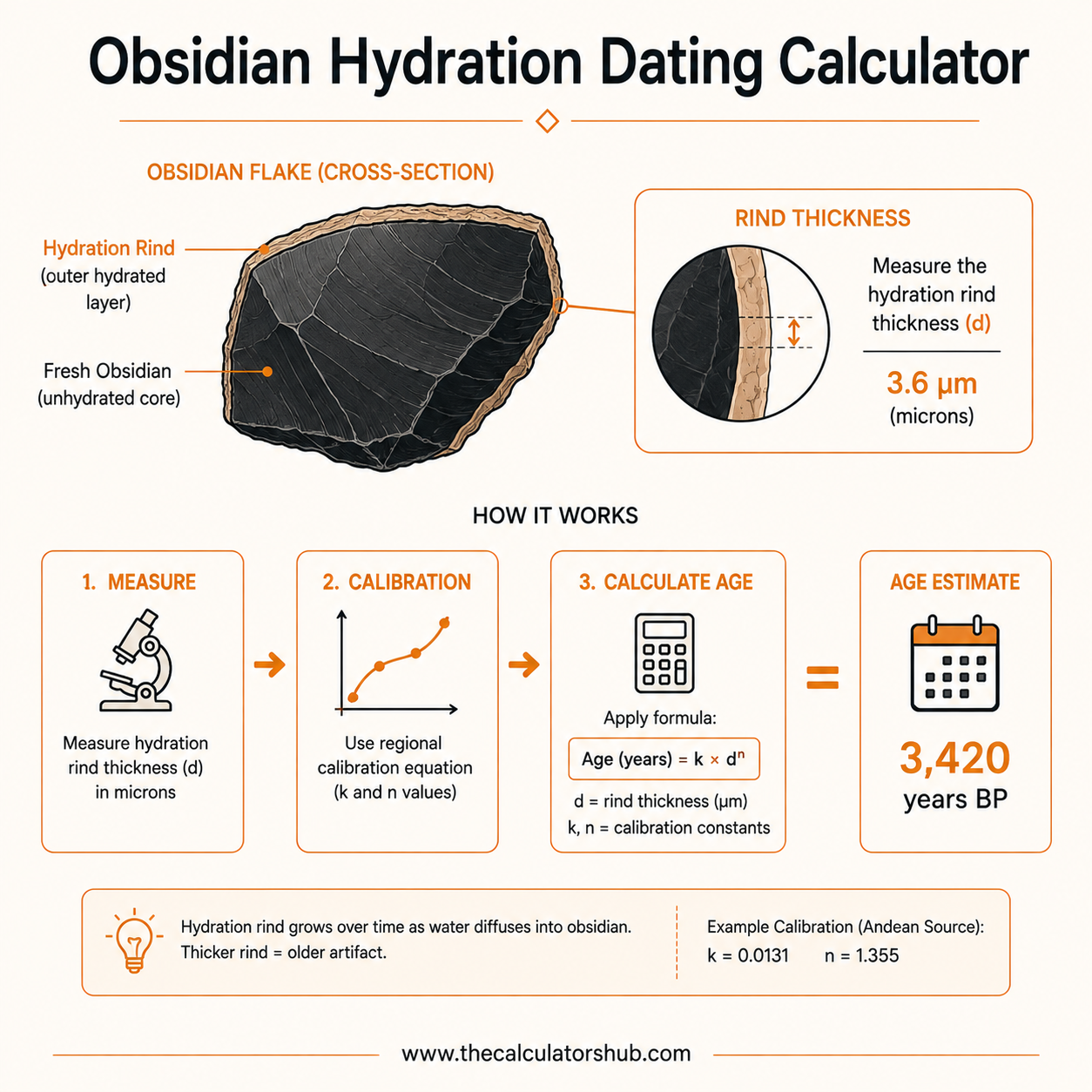
This tool works out an artifact's estimated age from a measured hydration rim thickness and a source-specific rate constant, and it works the relationship in reverse, back-calculating a local rate constant from a hydration rim measured on obsidian tied to a context of independently known age. According to Wikipedia's overview of obsidian hydration dating, freshly exposed obsidian surfaces absorb atmospheric water in a measurable, time-dependent rind, and the thickness of that rind provides a relative or, with the right calibration, an absolute age estimate.
The Hydration Rim and the Quadratic Diffusion Law
Rim Thickness | Rate Constant | Estimated Age |
|---|---|---|
2.0 microns | 5.0 µm²/ka | ~800 years |
4.2 microns | 5.0 µm²/ka | ~3,528 years |
6.0 microns | 5.0 µm²/ka | ~7,200 years |
Water diffuses into a freshly exposed obsidian surface at a rate that, under reasonably stable conditions, follows a quadratic relationship: the square of the hydration rim thickness equals the rate constant multiplied by elapsed time, so age works out to rim thickness squared divided by the rate constant. As the summary of obsidian hydration dating science and method lays out, the rim is conventionally measured on a thin cross-section under polarized light microscopy, where the hydrated layer shows distinct optical contrast against the unhydrated glass beneath it.
Why the Rate Constant Must Be Locally Calibrated, Not Assumed
The rate constant is not a universal number; it depends on the specific obsidian source's intrinsic structural water content and the effective hydration temperature (EHT) the artifact actually experienced, both of which vary from source to source and region to region. A study of Topaz Mountain obsidian, published in a diffusion theory analysis of effective hydration temperature, reports a hydration rate specific to that single source, figures that do not transfer to a different obsidian source. The standard way a rate constant gets established is by measuring hydration rims on obsidian recovered from a context that also produced organic material suitable for radiocarbon dating, working backward from that independently known age, as documented in an improved equation for Coso obsidian hydration dating.
Accuracy and Limitations
The arithmetic in both directions is exact given accurate rim thickness and rate constant or age inputs. Research on the accuracy and resolution limits of obsidian hydration dating found that intra-source intrinsic water variability is by far the largest contributor to age uncertainty, ahead of temperature-related uncertainty. An error of only a few degrees in estimated effective hydration temperature can shift a resulting date by several centuries, given the exponential, Arrhenius-type relationship between temperature and hydration rate that this simplified quadratic calculator does not model directly. Burial environment plays into this too: an artifact that spent part of its history in sun-exposed surface soil and part deeply buried experienced a different effective temperature history than one that stayed at constant depth throughout.
Calibrating a Rate Constant from an Associated Radiocarbon Date
Carry out this calibration using several independently dated contexts where possible rather than a single association, since one radiocarbon date paired with one hydration rim gives a single calibration point with no way to check its own reliability against the source's broader behavior. Once calibrated, that rate constant is considered representative only for that source and for other artifacts that plausibly shared a similar temperature history. Once a source-specific rate constant is properly calibrated, our Radiocarbon Calibration Calculator and Thermoluminescence Age Estimator provide independent age cross-checks for the same context.
Frequently Asked Questions

Muhammad Shahbaz Siddiqui
Founder, TheCalculatorsHub
How I used the Obsidian Hydration Dating Calculator to catch a borrowed rate constant that didn't belong to the site's obsidian
A cultural resource management report crossed my desk in 2025, assigning an age of roughly 2,400 years to a projectile point based on a 3.1-micron hydration rim, using a rate constant the analyst had pulled from a nearby published site report for convenience. The two sites sat only about 40 kilometers apart, and the report treated the borrowed rate constant as close enough given the similar regional climate.
Running the numbers the other way first, using the calibration mode against a radiocarbon-dated hearth feature from the same site that had also produced obsidian debitage, gave a rate constant meaningfully different from the one the report had borrowed. Checking the trace-element sourcing data included earlier in the same report explained why: the site's obsidian actually sourced to a different volcanic flow than the neighboring site's material, despite the geographic proximity, and that source difference was enough on its own to produce a different intrinsic water content and a different calibrated rate.
Recalculating the projectile point's age using the site's own properly calibrated rate constant shifted the estimate from roughly 2,400 years to closer to 1,850 years, a meaningful difference for the chronological argument the report was building. The final report was revised to include the site-specific calibration explicitly, and the analyst adopted a standing rule of checking XRF sourcing data against any borrowed rate constant before using it again.