

How It Works
Our engine processes your inputs using verified datasets and logic models to provide real-time results.
Efficiency Tips
Ensure data accuracy for the most reliable interpretation.
Compare results across different scenarios to find the optimal path.
Did you know?
Using standardized tools reduces manual error by up to 95% in complex calculations.
Related Expert Tools
More precision tools in the same niche.
Bayesian Age-Depth Model Calculator
The Age-Depth Model Calculator interpolates the estimated calibrated age at any depth in a sediment or stratigraphic core from your dated control points, and automatically flags age reversals that would otherwise distort a chronology. It also explains what full Bayesian, Bacon-style modeling adds beyond simple linear interpolation, and reports a simplified uncertainty estimate alongside the interpolated age.
BP to BCE/CE Converter
The BP to BCE/CE Converter turns a years-before-present figure into a calendar year and back again, correctly subtracting 1949 rather than 1950 when a date crosses into BCE, since the Gregorian calendar has no year zero. It also includes an optional marine reservoir (delta-R) adjustment for converting shell and marine sample dates.
Potassium-Argon Dating Calculator
The Potassium-Argon Dating Calculator works out a K-Ar age from measured argon-40 and potassium-40, using the Steiger and Jager (1977) IUGS-recommended decay constants. It corrects raw argon-40 measurements for atmospheric contamination using measured argon-36, flags samples with a low radiogenic percentage, and explains the excess argon problem that can push ages older than the true value.
Thermoluminescence Age Estimator Logic
Why Alpha Dose Rate Can't Just Be Added In
The mistake I see most often is combining raw alpha, beta, and gamma dose rate figures directly without applying an alpha-efficiency correction first, which overstates the true dose rate and produces an age that reads younger than the sample actually is. Always confirm which a-value a lab report used, or select the appropriate material preset here, before comparing two TL age results against each other, since a mismatch in that one correction is enough to explain an apparent discrepancy of 20 to 30% between otherwise comparable measurements. Treat any TL age as a working estimate within its stated uncertainty range rather than a single precise number, a gap discussed plainly in this overview of thermoluminescence testing.
What the Thermoluminescence Age Estimator Actually Does
This tool works out the age of a fired or heated crystalline material, such as pottery or burnt flint, from its equivalent dose and environmental dose rate. Archaeologists use it to estimate how long ago an object was last heated past roughly 500°C, the point at which its trapped radiation signal resets to zero. According to Wikipedia's overview of thermoluminescence dating, firing pottery erases the crystals' accumulated signal and sets a fresh "time zero," after which the signal builds back up at a rate set by the surrounding environment's radioactivity. This calculator is scoped around combining already-measured dose rate components correctly; the DRAC calculator from Aberystwyth University is the field's established tool for deriving dose rate from raw radionuclide concentrations.
The Age Equation: Equivalent Dose Divided by Dose Rate
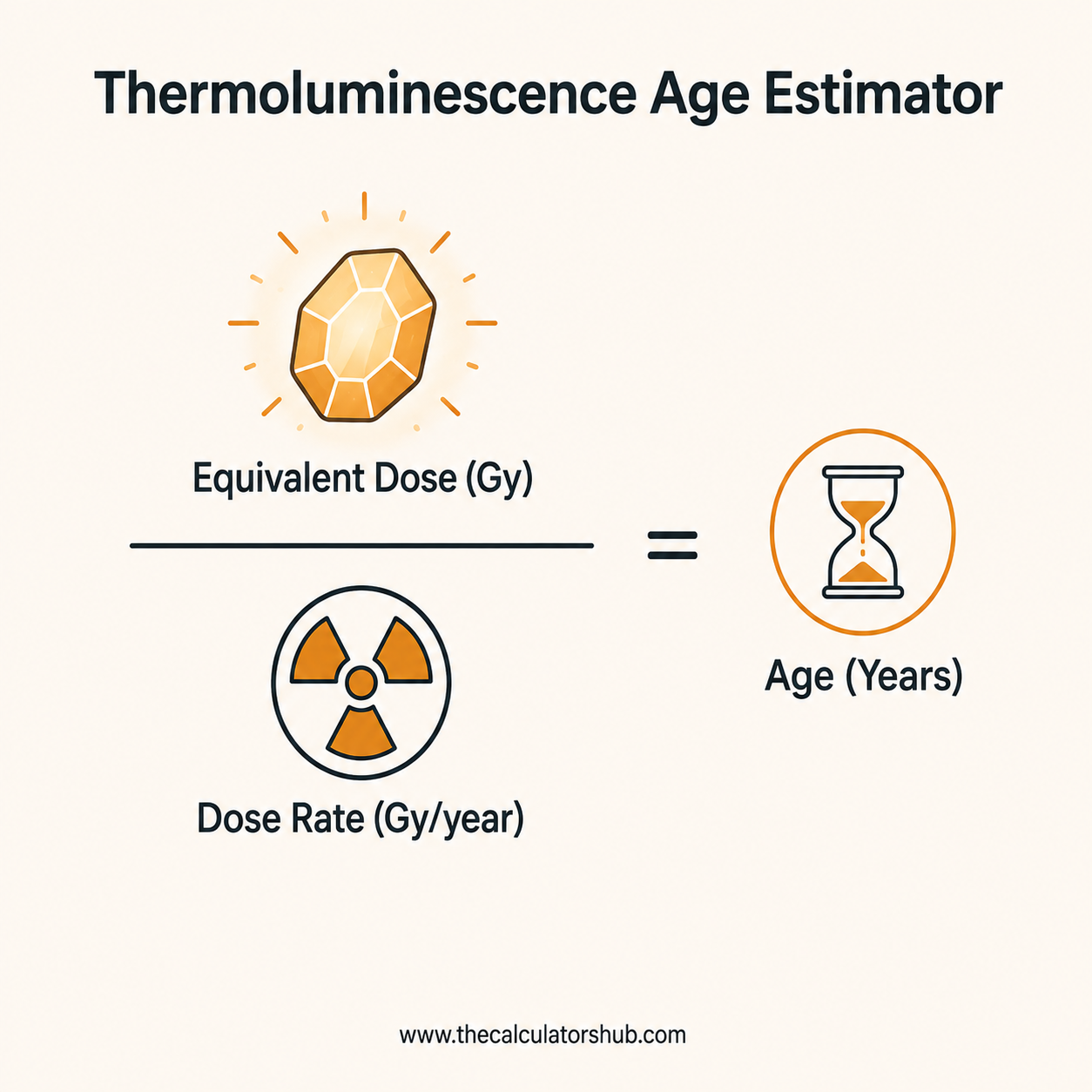
The core formula is age equals the equivalent dose (paleodose), measured in Gray, divided by the total annual dose rate, in Gray per thousand years. The dose rate comes from the sample's surrounding radioactivity, primarily uranium, thorium, and potassium decay, plus cosmic rays and internal radioactivity. Getting this denominator right is where most of the real complexity lives, since a dose rate off by even 10% carries directly through to the same percentage error in the final age. Most reported dose rates arrive as separate alpha, beta, gamma, cosmic, and internal figures rather than a single pre-combined number.
Why Alpha Radiation Needs a Separate Efficiency Correction
Material / Context | Typical Alpha Efficiency (a-value) |
|---|---|
Quartz, linear beta-dose response | ≈ 0.03 |
Coarse-grained quartz (ESR dating) | 0.07 ± 0.01 |
Calcite, 280°C TL peak | 0.20 ± 0.01 |
Alpha particles are considerably less efficient at producing a measurable TL signal than beta or gamma radiation carrying the same absorbed dose. Research measuring alpha efficiency in coarse-grained quartz confirms these values are material-specific and measured experimentally. Multiply the raw alpha dose rate by the correct a-value before adding it to beta and gamma; skipping this step is one of the most common ways a simple dose-rate sum ends up meaningfully wrong.
Correcting for Burial Water Content
Water in burial sediment absorbs some radiation before it reaches the sample, reducing the effective dose rate compared to a dry-sample measurement. This calculator applies the widely used Zimmerman (1971) approximation, dividing the combined dose rate by (1 + 1.25 × water content as a fraction of dry mass). Even a modest 15 to 20% water content can measurably lower the effective dose rate and push the calculated age older than an uncorrected figure would suggest. Once you have a working dose rate, our Age-Depth Model Calculator can incorporate a TL-derived date alongside radiocarbon control points from the same sequence.
Accuracy and Limitations
The arithmetic combining dose rate components with the correct alpha efficiency and water content correction is exact given accurate inputs. Thermoluminescence dating itself carries typical uncertainties in the range of 5 to 10% even under careful laboratory conditions, and is generally regarded as less precise than radiocarbon dating where both are applicable. This tool cannot derive dose rate from raw radionuclide concentrations the way DRAC does, and cannot detect problems such as disequilibrium in the uranium or thorium decay series, which requires specialist laboratory measurement.
Frequently Asked Questions

Muhammad Shahbaz Siddiqui
Founder, TheCalculatorsHub
How I used the Thermoluminescence Age Estimator to explain why two labs reported different ages for the same pottery sherd
Back in 2014, a small museum sent me two thermoluminescence age results for the same pottery sherd, run years apart by different labs as part of an authentication review. The first report gave an age consistent with the piece's claimed period; the second, more recent report gave an age roughly 30% younger, and the museum's board wanted to know before a scheduled sale whether the piece's authenticity was now in doubt.
Requesting the underlying dose-rate breakdowns from both labs, the difference traced back to how each had treated the alpha radiation component. The earlier report had combined the raw alpha, beta, and gamma dose rates directly without applying an alpha-efficiency correction, effectively treating alpha radiation as equally efficient at producing the TL signal as beta and gamma, which published dosimetry research on alpha efficiency in trapped-charge dating confirms is not the case; alpha particles are considerably less efficient per unit of absorbed dose. The more recent lab had applied a standard alpha-efficiency value appropriate to the sample's mineral composition, correctly scaling down the alpha contribution before combining it with the other dose rate components.
Once the older report's dose rate was recalculated with the same alpha-efficiency correction the newer lab had used, the two ages converged to within the field's normal 5 to 10% measurement uncertainty range, resolving the apparent 30% discrepancy entirely as a methodology difference rather than evidence the piece was inauthentic. The museum's board proceeded with the sale, and the auction house's own condition report was updated to note that the original, uncorrected age figure should not be relied upon for comparison against the corrected result.