

How It Works
Our engine processes your inputs using verified datasets and logic models to provide real-time results.
Efficiency Tips
Ensure data accuracy for the most reliable interpretation.
Compare results across different scenarios to find the optimal path.
Did you know?
Using standardized tools reduces manual error by up to 95% in complex calculations.
Related Expert Tools
More precision tools in the same niche.
Bayesian Age-Depth Model Calculator
The Age-Depth Model Calculator interpolates the estimated calibrated age at any depth in a sediment or stratigraphic core from your dated control points, and automatically flags age reversals that would otherwise distort a chronology. It also explains what full Bayesian, Bacon-style modeling adds beyond simple linear interpolation, and reports a simplified uncertainty estimate alongside the interpolated age.
Potassium-Argon Dating Calculator
The Potassium-Argon Dating Calculator works out a K-Ar age from measured argon-40 and potassium-40, using the Steiger and Jager (1977) IUGS-recommended decay constants. It corrects raw argon-40 measurements for atmospheric contamination using measured argon-36, flags samples with a low radiogenic percentage, and explains the excess argon problem that can push ages older than the true value.
Radiocarbon Calibration Calculator
The Radiocarbon Calibration Calculator works out the conventional radiocarbon age from a lab-reported percent modern carbon or delta-14C measurement, using the standard Libby half-life convention. It also applies the marine reservoir correction (delta-R) needed for shell and marine samples, and converts a calibrated cal BP figure into a BCE or CE calendar year.
BP to BCE/CE Converter Logic
Why Subtracting 1950 Instead of 1949 Gets the Wrong Year
Subtracting 1950 instead of 1949 the moment a BP date crosses into BCE territory, producing a calendar year off by exactly one, is the mistake I see most often, even in otherwise careful writing. Always check which side of the BCE/CE boundary a converted date lands on before publishing or presenting it, since the missing year-zero adjustment is easy to forget in a quick mental calculation. Double-check whether a source's "BP" figure is calibrated or raw before converting it at all, since applying this simple subtraction to an uncalibrated conventional radiocarbon age produces a number that looks precise but is not actually a calendar year. This boundary confusion turns up often enough that it shows up as a recurring question on public forums, exactly why checking the direction and correct offset every time, rather than relying on memory, is worth the extra few seconds.
What the BP to BCE/CE Converter Actually Does
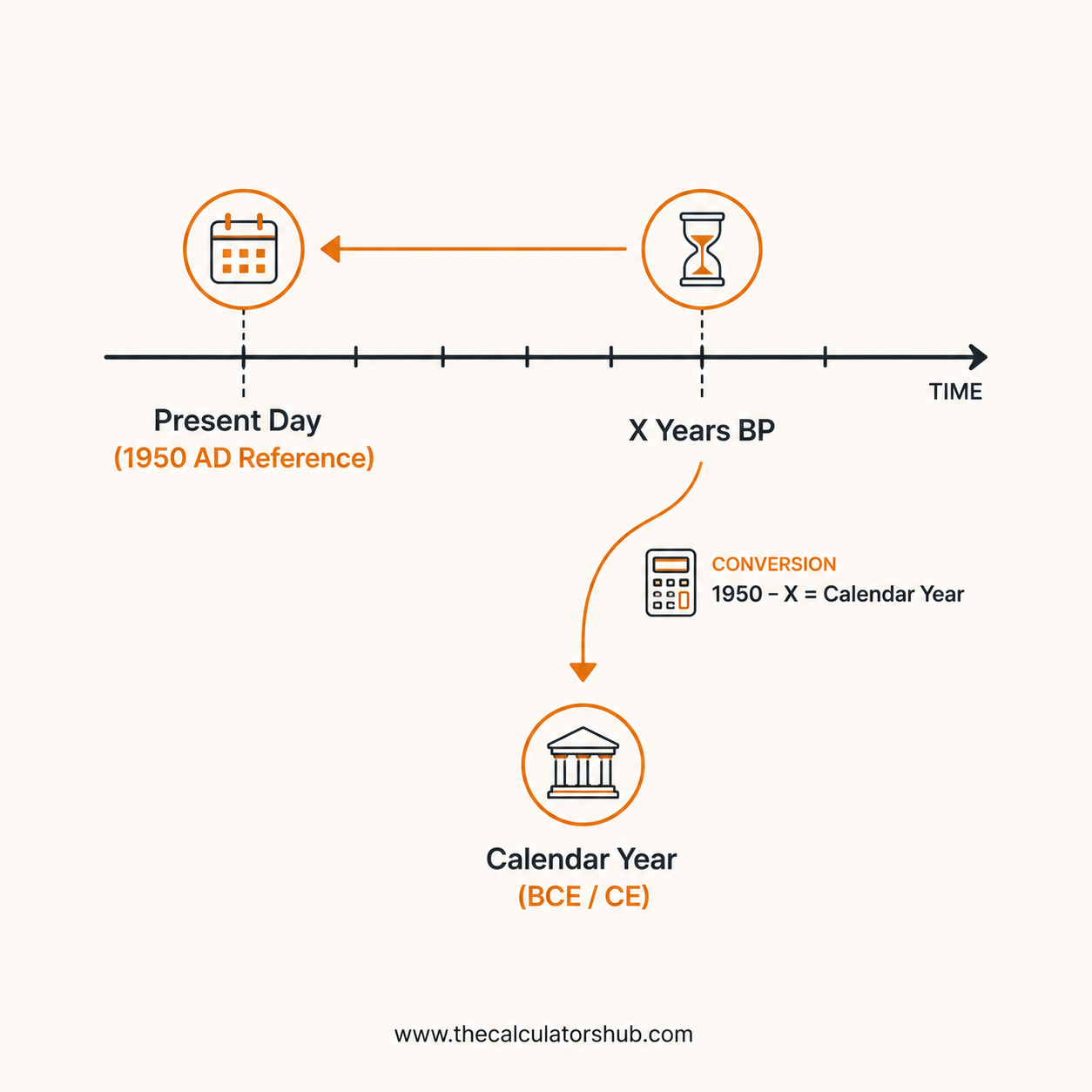
This tool turns a "years before present" figure into a standard calendar year, and works the reverse direction too, converting a BCE or CE year back into BP. Archaeologists, geologists, and students use it to move between the two dating conventions correctly, including the small but real adjustment needed when a date crosses from the Common Era into BCE. According to Wikipedia's overview of the Before Present dating convention, 1 January 1950 was fixed as the origin point for the BP scale, tied to the early years of radiocarbon dating rather than to whatever year a reader happens to be living in. That fixed 1950 reference point is what makes BP dates comparable across decades of published research, but it is also exactly where simple manual conversions tend to go wrong.
The No-Year-Zero Rule
Converting a BP date to CE is simple subtraction: calendar year = 1950 minus BP. A date of 1,000 BP becomes 950 CE, and the arithmetic works cleanly because both 1950 and the resulting year sit in the Common Era. Converting a BP date landing before the Common Era needs an extra step, since the Gregorian calendar has no year zero, year 1 BCE is immediately followed by year 1 CE, with nothing in between. A widely cited academic reference on AD, BC, and BP year conventions walks through exactly why this missing year trips up so many manual conversions, requiring subtracting 1949, not 1950, to account for the missing year.
BP Value | Naive Subtraction (1950) | Correct Conversion |
|---|---|---|
1,000 BP | 950 CE | 950 CE (correct, stays in CE) |
1,949 BP | 1 CE | 1 CE (correct, boundary year) |
1,950 BP | 0 BCE (does not exist) | 1 BCE |
2,000 BP | 50 BCE (off by one) | 51 BCE |
Why 1950 Is the Reference Point
The choice of 1950 is not arbitrary. Radiocarbon dating was developed in the late 1940s, and atmospheric nuclear weapons testing beginning in the early 1950s injected large amounts of artificial carbon-14 into the atmosphere, permanently distorting the natural ratio scientists rely on for dating. Fixing "the present" at 1 January 1950, just before that distortion began, gave the field a stable, unchanging reference point rather than one drifting every year as new dates were published. Not everyone in the field is fully satisfied with keeping BP as the standard going forward, a 2013 paper in the journal Radiocarbon, titled "BP, Time for a Change," argues the community should consider updating the convention, partly because BP is sometimes mistakenly assumed to mean only radiocarbon-derived dates when it is also used more broadly for stratigraphic and other dating methods. That debate has not changed the working standard, so 1950 remains the reference point this converter, and the rest of the field, uses.
Marine Reservoir Adjustment Before Converting
If the BP figure being converted comes from a marine shell or other ocean-derived sample, apply the local marine reservoir correction (Delta-R) before running the calendar conversion, not after. The optional Delta-R field in this tool subtracts that adjustment from the entered BP value first, so the calendar year reflects the corrected age rather than the raw, artificially old marine reading. Look into the Marine Reservoir Correction Database for a sample's specific region before entering a value, since local offsets vary considerably and a generic average can shift a converted date by decades. Our Radiocarbon Calibration Calculator works out the conventional radiocarbon age and correct local Delta-R first if starting from a raw lab measurement rather than an already-calibrated cal BP figure, since this converter assumes the BP value entered is already calibrated.
Accuracy and Limitations
The BP-to-calendar arithmetic here is exact once the input is a genuinely calibrated cal BP figure. It cannot tell the difference between a calibrated age and a raw, uncalibrated conventional radiocarbon age, converting the latter directly produces a calendar year that does not correspond to the sample's true age, since it skips calibration against IntCal20, SHCal20, or Marine20 entirely. Return to the Radiocarbon Calibration Calculator to check whether a figure needs calibrating first before converting it here. It also assumes the standard 1950 epoch throughout, a small number of older publications used other reference years, which this tool does not attempt to detect automatically. If unsure whether a source figure is calibrated, treat it as raw and carry out the calibration step at CALIB or OxCal before trusting a converted calendar date for anything beyond a rough estimate.
Frequently Asked Questions

Muhammad Shahbaz Siddiqui
Founder, TheCalculatorsHub
How I used the BP to BCE/CE Converter to catch an off-by-one-year error in a museum exhibit label
A small local history museum asked me, back in 2012, to review the date labels on a new exhibit about a nearby archaeological site before it opened to the public. One label read "2000 BP", and the volunteer who wrote the accompanying panel had converted it by simple subtraction, 1950 minus 2000, and rounded the resulting negative number to "50 BCE" for the wall text.
Running the same figure through the converter's calendar-conversion mode gave a different answer: 51 BCE, not 50 BCE. The gap is small but real, and it comes from a detail most casual conversions miss entirely. There is no year zero between 1 BCE and 1 CE in the standard calendar, so converting a BP date that falls before the Common Era requires subtracting 1949, not 1950, to account for that missing year. Wikipedia's overview of the Before Present dating convention confirms 1 January 1950 as the fixed epoch, but the asymmetric subtraction across the BCE/CE boundary is the part that trips up manual conversions specifically.
A single year of difference did not change the exhibit's historical narrative, but the museum's collections manager asked me to re-check every BP-labelled date in the new exhibit against the correct formula rather than trust the volunteer's spreadsheet, since a visiting archaeologist or professor was scheduled to review the exhibit before its public opening. Three further labels turned out to have the same off-by-one error, all silently corrected before the opening date, avoiding what could have been a visible, easily-criticized error on a professionally reviewed public exhibit.