

How It Works
Our engine processes your inputs using verified datasets and logic models to provide real-time results.
Efficiency Tips
Ensure data accuracy for the most reliable interpretation.
Compare results across different scenarios to find the optimal path.
Did you know?
Using standardized tools reduces manual error by up to 95% in complex calculations.
Related Expert Tools
More precision tools in the same niche.
Bayesian Age-Depth Model Calculator
The Age-Depth Model Calculator interpolates the estimated calibrated age at any depth in a sediment or stratigraphic core from your dated control points, and automatically flags age reversals that would otherwise distort a chronology. It also explains what full Bayesian, Bacon-style modeling adds beyond simple linear interpolation, and reports a simplified uncertainty estimate alongside the interpolated age.
BP to BCE/CE Converter
The BP to BCE/CE Converter turns a years-before-present figure into a calendar year and back again, correctly subtracting 1949 rather than 1950 when a date crosses into BCE, since the Gregorian calendar has no year zero. It also includes an optional marine reservoir (delta-R) adjustment for converting shell and marine sample dates.
Potassium-Argon Dating Calculator
The Potassium-Argon Dating Calculator works out a K-Ar age from measured argon-40 and potassium-40, using the Steiger and Jager (1977) IUGS-recommended decay constants. It corrects raw argon-40 measurements for atmospheric contamination using measured argon-36, flags samples with a low radiogenic percentage, and explains the excess argon problem that can push ages older than the true value.
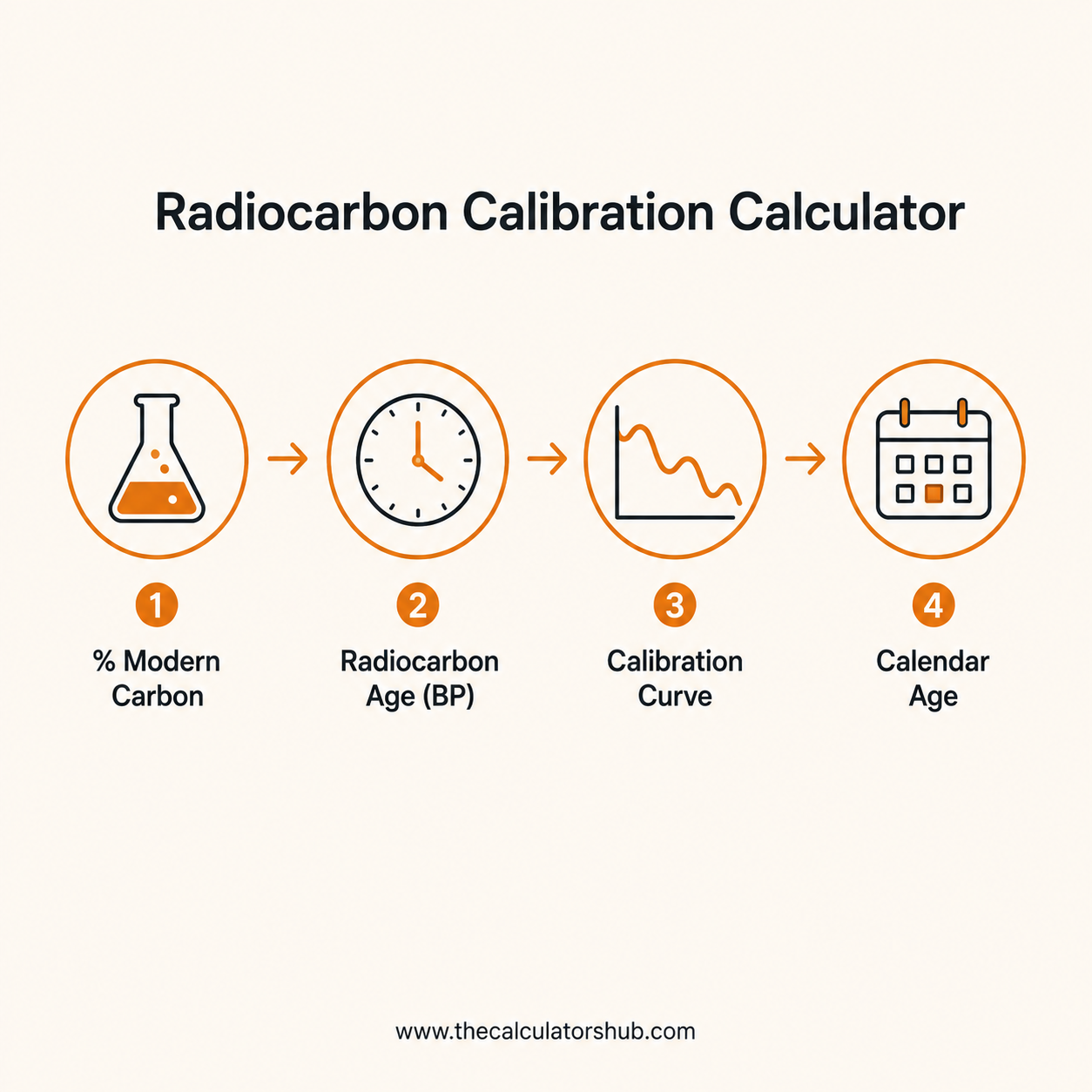
Radiocarbon Calibration Calculator Logic
 Why "3,000 BP" Doesn't Mean 3,000 Years Before 1950
Treating a lab's reported "BP" figure as though it were already a calendar year, subtracting it from 1950 and calling that the site's age, is the mistake I see most often, even among people with some archaeology background. Always confirm whether a reported age is the raw conventional radiocarbon age or an already-calibrated cal BP figure before doing any arithmetic with it, since only the calibrated version behaves like a normal calendar year. When a site produces both marine and terrestrial samples, apply the correct reservoir correction to the marine ones before drawing conclusions about which layer is older, since an uncorrected comparison can make two genuinely contemporaneous events look centuries apart.
What the Radiocarbon Calibration Calculator Actually Does
This tool works out the conventional radiocarbon age of a sample from a lab-reported measurement, applies the marine reservoir correction needed for shell and marine samples, and converts a calibrated calendar age between cal BP and BCE/CE. Archaeologists, students, and researchers use it to check a lab result, understand what a reported "BP" figure actually means, and correctly compare marine and terrestrial dates from the same site. According to the IntCal20 calibration curve paper, converting a raw radiocarbon measurement into a calendar age requires comparing it against a curve built from thousands of independently dated samples, not a simple formula. This tool is deliberately scoped around the parts of the process that are exact, the conventional age formula and the reservoir correction, while pointing to dedicated calibration programs for the curve-matching step itself.
From Lab Measurement to Conventional Radiocarbon Age
A radiocarbon lab typically reports activity as percent modern carbon (pMC) or as Delta-14C in per mille. The conventional age follows t = -8033 x ln(pMC / 100), where 8033 years is the Libby mean life. That 8033-year figure comes from the Libby half-life of 5,568 years, not the true physical half-life of carbon-14, the true, more precisely measured half-life, sometimes called the Cambridge half-life, is 5,730 +/- 40 years. Beta Analytic's explanation of radiocarbon dating conventions confirms that, by international agreement, every laboratory still reports conventional ages using the older Libby figure, specifically so results published across nine decades of radiocarbon research stay directly comparable rather than needing constant retroactive adjustment. This calculator shows both the standard Libby-based age and what the same measurement would produce under the true half-life, so the roughly 3% gap between them does not come as a surprise later.
Why a Reported "BP" Age Is Not a Calendar Date
The atmospheric ratio of carbon-14 to carbon-12 has not stayed constant through history. Solar activity, geomagnetic field changes, and ocean carbon exchange have all pushed it up and down over the millennia, so a straight-line formula from measured carbon-14 to calendar year would be wrong by centuries at some points. Wikipedia's overview of radiocarbon calibration covers this clearly: calibration curves correct for that historical variation, built from tree rings, corals, and other materials with independently known ages, cross-referenced against their own radiocarbon measurements. A conventional radiocarbon age of 3,000 BP does not automatically mean 3,000 calendar years ago, and depending on where that age falls on the curve, including notorious flat "plateau" regions where the curve barely moves for centuries, the true calendar range can span a wider or narrower window than the lab's stated measurement uncertainty alone would suggest. Run the actual curve-matching step in a dedicated program such as OxCal, maintained by the University of Oxford, or CALIB, against IntCal20, SHCal20, or Marine20 for a proper probability-based calendar range.
The Marine Reservoir Effect and Local Correction
Marine shell, fish bone, and other ocean-derived samples carry an added complication. Deep ocean water takes centuries to mix with the surface, so marine organisms build tissue from carbon measurably older than the contemporary atmosphere, making every marine conventional age read artificially old by a global average of roughly 400 years, on top of a local deviation (Delta-R) that varies by ocean region. The Marine Reservoir Correction Database, maintained alongside CALIB, publishes region-specific values drawn from paired shell and known-age samples worldwide.
Component | Where It Applies | Typical Size |
|---|---|---|
Global reservoir offset (R) | Already built into the Marine20 curve | ~400 years |
Local Delta-R | Must be looked up and subtracted separately | Roughly -100 to +1,000 years, region-dependent |
Uncorrected direct comparison | Marine vs terrestrial date from the same layer | Can appear several hundred years apart in error |
Look up the published Marine Reservoir Correction Database for a specific coastline rather than assuming a textbook average applies, since local values genuinely range from near zero to over a thousand years depending on upwelling patterns and ocean circulation. Never compare a raw marine conventional age directly against a terrestrial one from the same layer without applying this correction first.
Accuracy and Limitations
The conventional age formula and the reservoir arithmetic here are exact, standard equations used throughout the field. This tool does not embed the full IntCal20, SHCal20, or Marine20 calibration curves, large, regularly updated datasets built from thousands of independently dated samples, and it does not carry out probability-based calendar range calculation the way CALIB or OxCal do. Treat the figures here as the correct inputs to prepare before calibration, not as a replacement for running the actual curve match in a dedicated program, since getting the conventional age formula, the half-life convention, and the reservoir correction right beforehand is exactly where a surprising number of avoidable errors happen.
Getting the Inputs Right Before Calibration
The three most common sources of error before any curve-matching even starts are confusing pMC with an already-converted age, applying the true carbon-14 half-life instead of the internationally agreed Libby convention, and skipping the marine reservoir correction on shell or fish bone samples. Working through this calculator's three modes in order, conventional age, reservoir correction, and cal BP to BCE/CE conversion, catches each of these before a figure ever reaches a dedicated calibration program.
Frequently Asked Questions

Muhammad Shahbaz Siddiqui
Founder, TheCalculatorsHub
How I used the Radiocarbon Calibration Calculator to explain why a volunteer's shell midden date looked "too old" by 400 years
A community archaeology project on the Atlantic coast brought me in back in 2016 to help interpret a radiocarbon result from a shell midden layer, submitted to a lab as marine shell rather than the charcoal samples from the rest of the site. The lab reported a conventional radiocarbon age, and the volunteer coordinator compared it directly against charcoal dates from an adjacent layer, concluding the midden was roughly 400 years older than the stratigraphy actually suggested it should be, since a marine sample and a terrestrial sample from around the same depositional event had come back looking centuries apart.
Running the shell sample's conventional age through the reservoir correction tool made the discrepancy make sense immediately. Marine organisms take up carbon from ocean water that is depleted in 14C relative to the atmosphere because of the time it takes surface water to mix with deeper reservoirs, so a marine shell always reads artificially older than a terrestrial sample from the same actual date, typically by several hundred years globally before any local adjustment. Subtracting the region's published local ΔR value, sourced from the Marine Reservoir Correction Database rather than guessing, brought the shell's calibration-ready age back in line with the charcoal dates from the same stratigraphic layer, closing almost exactly the 400-year gap that had looked like a genuine chronological problem.
The coordinator flagged this as a lesson for the rest of the volunteer team: never compare a marine-shell conventional age directly against a terrestrial conventional age without applying the reservoir correction first, since the two are only comparable once each has gone through the correct calibration curve, Marine20 for the shell and IntCal20 for the charcoal. The project's final site report included both the corrected and uncorrected figures side by side specifically so future researchers reusing the dataset would not repeat the same direct-comparison mistake.