
What Is Projectile Motion? Definition, Formula, and Examples

Quick answer: Projectile motion is the curved path an object follows after being launched into the air, shaped by a constant horizontal velocity and a vertical velocity that gravity steadily slows, reverses, and speeds back up. Ignoring air resistance, every projectile traces a symmetric parabola, and launching at 45 degrees gives the maximum possible range for a given launch speed.
Throw a ball, fire an arrow, or launch a rocket-powered water balloon, and the path it traces looks curved and complicated at first glance. It isn't. Every one of those trajectories comes apart into two much simpler motions running at the same time, and once they're separated, the math behind where something lands turns out to be genuinely straightforward.
This guide sets out how projectile motion works, the three core formulas that predict a trajectory, and why 45 degrees has such a reputation as the "best" launch angle. To run the numbers on your own launch speed and angle, our Projectile Motion Calculator handles the full trajectory at once.
In this article:
How Projectile Motion Works
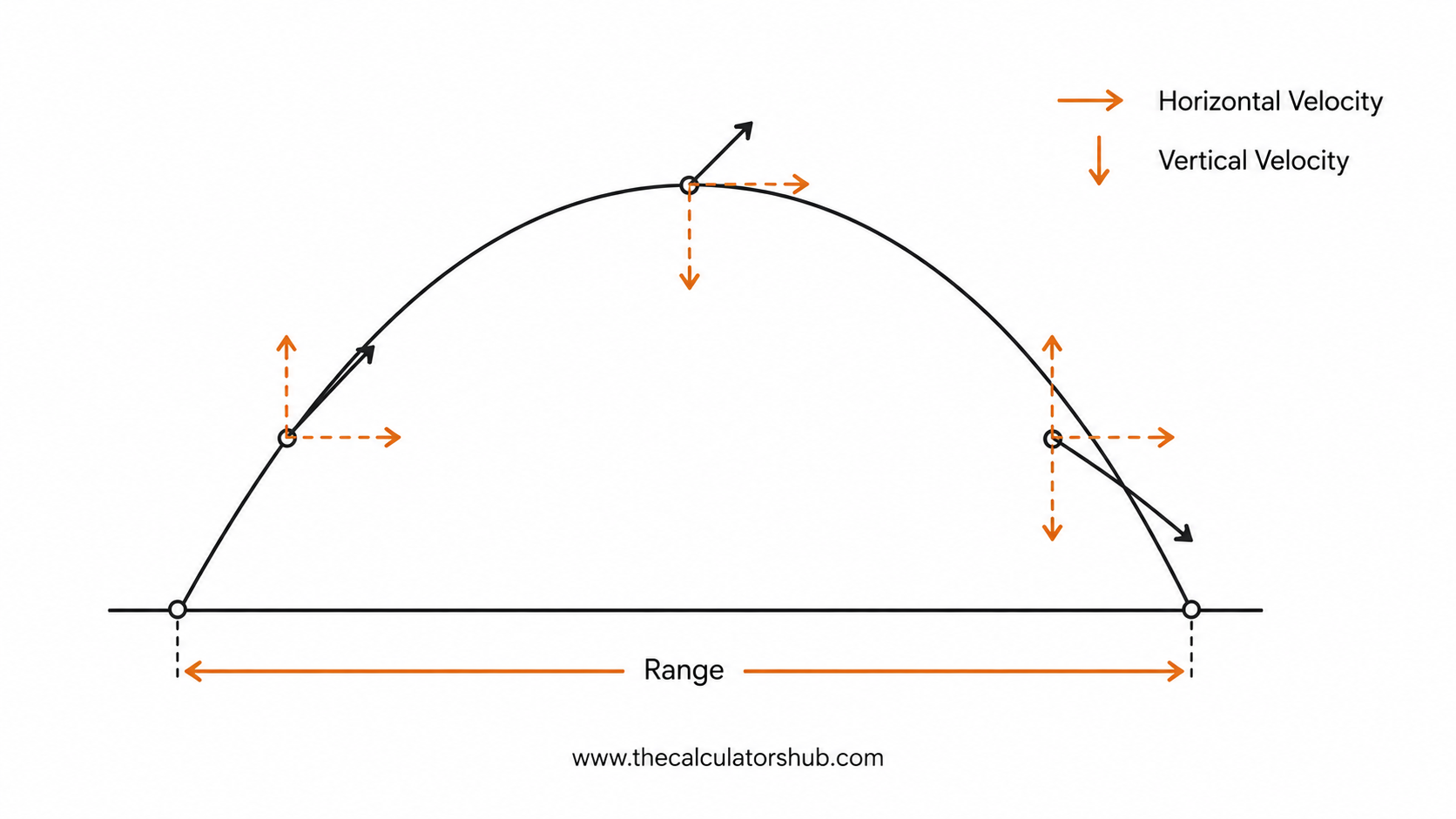
Projectile motion describes anything launched into the air and then left to move under gravity alone, with air resistance ignored. According to OpenStax Physics, the key insight is that the object's horizontal and vertical motion can be figured out completely independently of each other, even though they're happening to the same object at the same time.
Horizontally, there's no force acting on the projectile (again, ignoring air resistance), so horizontal velocity stays constant the whole flight. Vertically, gravity constantly pulls the object downward, slowing its upward velocity, bringing it to zero at the peak, then speeding it up again on the way down. Combine a constant horizontal speed with a steadily changing vertical speed and the result, plotted out, is a parabola.
Projectile Motion Formulas: Range, Height, and Time of Flight
For a projectile launched at speed u and angle θ from and landing at the same height, three formulas cover everything worth working out about the flight.
Time of Flight
T = 2u sinθ / g, where g is the acceleration due to gravity (9.8 m/s² on Earth). This is the total time from launch to landing.
Maximum Height
H = u² sin²θ / 2g. This is the highest point the projectile reaches, which occurs exactly halfway through the flight, at T/2, since the trip up and the trip down are symmetric.
Range
R = u² sin(2θ) / g. This is the total horizontal distance covered from launch to landing, and it's the formula most real-world questions ("how far will it go?") actually come back to.
Why 45 Degrees Gives Maximum Range
The range formula, R = u²sin(2θ)/g, is maximized whenever sin(2θ) hits its largest possible value of 1, and that happens exactly when 2θ = 90°, meaning θ = 45°. At that angle, the initial velocity splits evenly between horizontal and vertical components, which turns out to be the best trade-off between staying airborne long enough and moving forward fast enough.
Working out the range for a given launch speed and angle, or figuring out what angle gets a projectile to a specific target distance, is exactly what our Projectile Range Calculator is built to handle.
That said, 45 degrees only holds as the optimal angle under the idealized assumptions the formula was derived from, launching and landing at the same height, with no air resistance. Once either of those assumptions breaks (firing from a cliff, or accounting for drag), the true optimal angle shifts away from 45 degrees.
Complementary Angles and Trajectory Shape
Any two launch angles that add up to 90 degrees, 30° and 60°, or 20° and 70°, produce identical range for the same launch speed, since sin(2θ) gives the same result for θ and 90° - θ. What differs between the pair is everything else about the flight: the steeper angle (60°) reaches a greater maximum height and stays airborne longer, while the flatter angle (30°) stays low and lands sooner, even though both cover exactly the same ground distance.
This is a genuinely useful distinction in practice, a low, flat trajectory (below 45°) reaches its target faster and is harder to intercept, while a high, arcing trajectory (above 45°) can clear obstacles that a flatter shot would hit.
The Effect of Air Resistance
Every formula above assumes air resistance is negligible, which is a reasonable simplification for a thrown rock but breaks down for anything light, fast, or spinning. Drag opposes the direction of motion at every point along the trajectory, which shortens the range, lowers the maximum height, and, in most real cases, shifts the optimal launch angle to somewhat below 45 degrees.
According to Physics LibreTexts, accounting for drag properly requires solving the motion numerically rather than with the clean closed-form formulas above, since drag force depends on velocity, which is itself constantly changing throughout the flight. A spinning ball adds a further complication on top of that, the Magnus effect, which curves a trajectory sideways or lifts it depending on spin direction, is a big part of why pitchers and golfers put spin on a ball deliberately.
Real-World Examples of Projectile Motion
Sports offer some of the clearest everyday demonstrations: a basketball free throw, a golf drive, and a javelin throw are all projectile motion problems that athletes solve intuitively through practice, adjusting launch angle and speed to hit a target distance. Coaches and sports scientists increasingly formalize that intuition with the same range and height formulas covered above.
Ballistics is the more literal application, artillery and mortar trajectories are calculated with these same equations as a starting point, before layering in corrections for air resistance, wind, and even the Earth's rotation over very long ranges. Working out how high a launched object will climb before starting to fall, whether that's a thrown ball or a fired projectile, is exactly what our Maximum Height Projectile Calculator handles.
Even a garden hose demonstrates the principle: aim it too flat and the water lands close by, angle it up toward 45 degrees and the stream reaches its furthest point, angle it too steep and it arcs high but falls short, the exact trade-off the range formula describes.
Common Projectile Motion Mistakes
Applying horizontal reasoning to the vertical axis or vice versa: horizontal velocity stays constant throughout the flight, vertical velocity does not, mixing the two up is the most common setup error.
Assuming 45 degrees is always optimal: it only maximizes range when launch and landing heights are equal and air resistance is ignored, real-world optimal angles are often lower.
Forgetting that maximum height occurs at the midpoint of the flight, not the end: the peak happens at T/2, not at landing, a distinction that trips up time-based questions.
Ignoring that complementary angles share range but not flight time or height: 30° and 60° land in the same spot, but describe two very different trajectories getting there.
What I come back to most often when reviewing projectile problems is that nearly every error traces back to treating the motion as one combined thing instead of two independent ones running side by side. Look into which axis a given number belongs to before plugging it into a formula.
Frequently Asked Questions
What is the formula for projectile motion range?
The range formula is R = u²sin(2θ)/g, where u is launch speed, θ is the launch angle, and g is the acceleration due to gravity. This gives the horizontal distance covered when launch and landing heights are equal.
Why does a 45 degree launch angle give the maximum range?
At 45 degrees, sin(2θ) reaches its maximum possible value of 1, since 2 × 45° = 90°. This represents the best balance between horizontal speed and time spent airborne, for equal launch and landing heights with no air resistance.
Do 30 degrees and 60 degrees give the same range?
Yes, any two angles that add up to 90 degrees produce identical range for the same launch speed, since they're mathematically complementary in the range formula. They differ in flight time and maximum height though, the steeper angle climbs higher and stays airborne longer.
Does air resistance change the optimal launch angle?
Yes, air resistance reduces range and typically shifts the optimal angle to below 45 degrees, since a flatter trajectory spends less time exposed to drag. The exact optimal angle with drag depends on the object's mass, shape, and speed, and generally requires numerical calculation rather than a simple formula.
Where is a projectile's velocity zero during its flight?
The vertical component of velocity is zero at the exact peak of the trajectory, the moment of maximum height, but the horizontal component of velocity is never zero during flight, since nothing acts to slow it down. Overall speed is never fully zero until landing.
What's the difference between projectile motion and free fall?
Free fall is projectile motion with zero horizontal velocity, an object simply dropped straight down. Projectile motion is the more general case, adding a horizontal velocity component to the same vertical motion gravity produces during free fall.