
Percentage vs. Percentage Point vs. Percent Change: What's the Difference?
Quick answer: A percentage point is the raw arithmetic difference between two percentages (50% minus 40% is 10 percentage points), while percent change measures that same shift relative to the starting value ((10 ÷ 40) × 100, or 25%). The two numbers describe the same move but almost never match, which is exactly why a headline like "rates rose 2%" and "rates rose 2 percentage points" from a 5% base land on 5.1% and 7% respectively, a 1.9 percentage point gap between two ways of reporting the identical event.
Percentage, percentage point, and percent change get used almost interchangeably in everyday writing, and the mix-up isn't just a pedantic grammar issue, it changes the actual number being reported. A central bank raising rates "by 2 percentage points" and one raising rates "by 2 percent" are describing two different-sized moves, and mixing them up in a headline, a report, or a homework answer produces a genuinely wrong figure, not just an imprecise one.
This post works through what each term actually means, walks through the exact arithmetic with real numbers, and covers the specific places, interest rates, inflation, and polling, where this confusion shows up most often in the wild. If you just need to run the numbers, our Percentage Point Calculator and Percentage Change Calculator handle both versions of this calculation instantly.
In this article:
What Is a Percentage?
A percentage is simply a number expressed as a fraction of 100, the word itself comes from the Latin "per centum," meaning "by the hundred." 40% means 40 out of every 100, no more context needed to understand the value on its own. The confusion never starts here, it starts once two percentages get compared to each other.
What Is a Percentage Point?
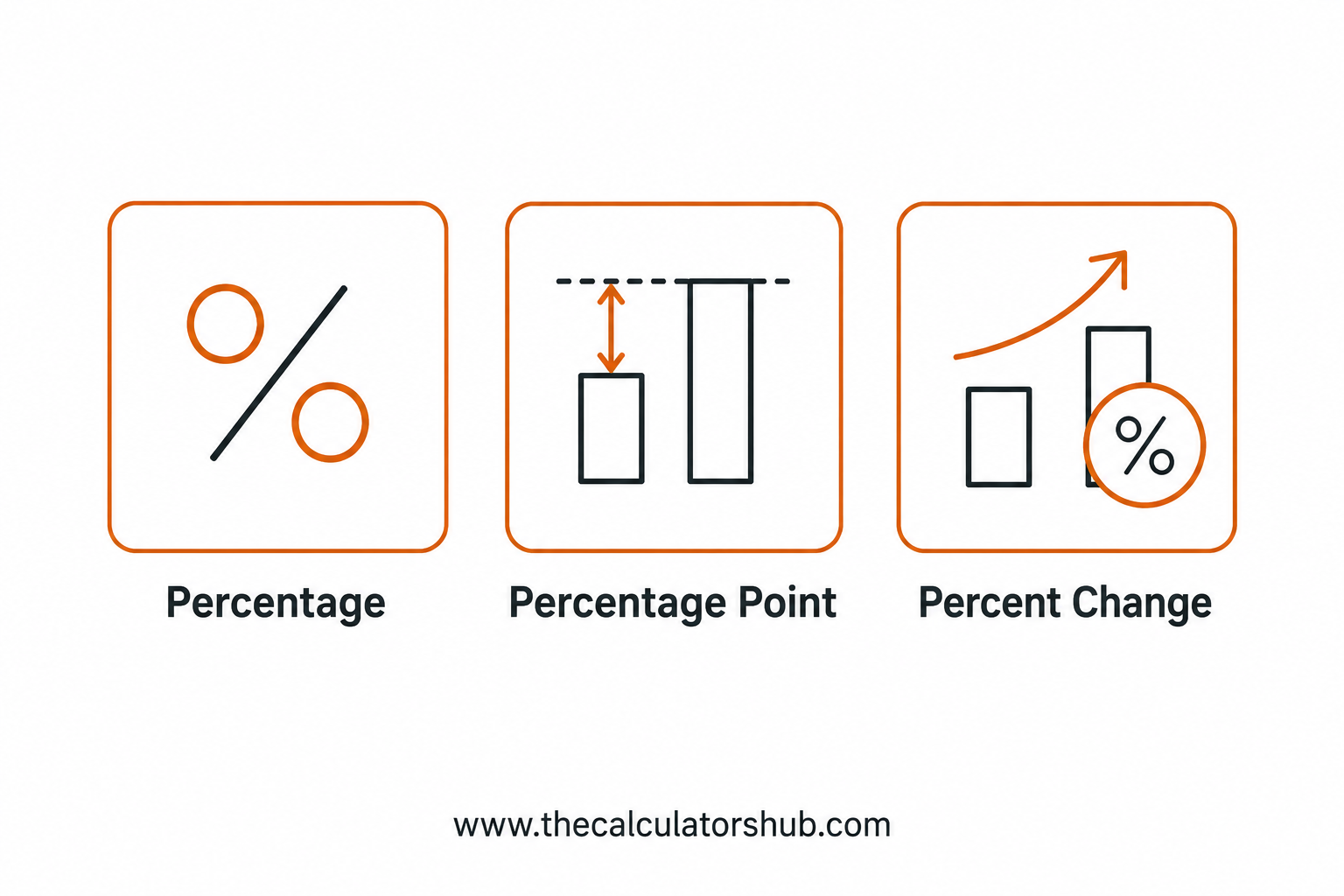
A percentage point is the plain arithmetic difference between two percentages, found by simple subtraction: New% minus Old%. If approval rating moves from 40% to 50%, the change is 50 minus 40, or 10 percentage points, full stop, no division involved. According to Macroption's breakdown of the term, a percentage point is an absolute unit, it measures the size of the gap itself, not the gap relative to where it started.
That's the entire distinction in one sentence: a percentage point answers "how far apart are these two numbers," while percent change answers "how big was that gap relative to the starting point."
What Is Percent Change?
Percent change takes the same gap and divides it by the starting value, then multiplies by 100: ((New − Old) ÷ Old) × 100. Using the same 40% to 50% move, the percentage point gap is 10, but the percent change is (10 ÷ 40) × 100, which works out to 25%. Both figures describe the exact same event, they're just answering different questions.
The smaller the starting value, the more percent change and percentage point diverge, which is exactly why this mix-up causes the most damage in low-base contexts like interest rates and unemployment figures, covered below.
Percentage Point vs. Percent Change: A Side-by-Side Example
Take unemployment moving from 4.2% to 4.0%, a realistic monthly jobs-report move. The percentage point change is straightforward: 4.0 minus 4.2, or −0.2 percentage points. The percent change tells a different-sounding story: (−0.2 ÷ 4.2) × 100 comes out to roughly −4.76%.
Metric | Percentage Point Change | Percent Change |
|---|---|---|
Approval rating: 40% → 50% | +10 points | +25% |
Unemployment: 4.2% → 4.0% | −0.2 points | −4.76% |
Polling support: 40% → 44% | +4 points | +10% |
Notice how a small, unremarkable-looking 0.2 percentage point drop in unemployment becomes an almost-5% relative swing once expressed as percent change, both numbers are correct, but they emphasize the move very differently depending on which one gets printed in a headline.
Why Interest Rates, Inflation, and Polling Get This Wrong So Often
Interest rate reporting is where this confusion carries the most real financial weight. Starting from a 5% base rate, a "2 percentage point" rise lands at 5 plus 2, or 7%. A "2 percent" rise, the relative version, lands at 5 × 1.02, or just 5.1%. That's a 1.9 percentage point gap between two headlines that sound nearly identical, on a mortgage or a central bank policy rate, that gap is the difference between a manageable adjustment and a genuinely painful one. It's exactly why financial reporting increasingly falls back on basis points instead, according to Journalist's Resource's guide to percent-change math, since one basis point equals a fixed 0.01 percentage point and removes the ambiguity entirely: a "25 basis point hike" always means exactly 0.25 percentage points, never a relative percentage.
Inflation reporting runs into the same trap from the other direction. If inflation moves from 3% to 5%, the percentage point change is a clean 2 points, but the percent change is (2 ÷ 3) × 100, or roughly 66.7%. A headline reading "inflation up 66.7%" is technically accurate in relative terms, but next to "inflation up 2 points" it describes the identical event in a way that reads far more alarming, which is exactly the kind of framing choice that misleads readers who don't catch which version they're looking at.
Election polling swings follow the same pattern: a candidate moving from 40% to 44% support is properly reported as a 4-point swing, the standard convention pollsters use, but a commentator translating that into "support rose 10%" isn't wrong exactly, they're just answering a different question than the one most readers assume they're asking.
How to Keep the Three Straight
If a comparison uses subtraction, it's a percentage point figure. "Rose from 40% to 50%" subtracted is 10 points.
If a comparison uses division against the starting value, it's percent change. The same move divided by 40 gives 25%.
The word "percent" alone in a headline is ambiguous unless the writer specifies which version they mean, when in doubt, look for the word "point(s)" as the signal it's the absolute figure.
The lower the starting percentage, the bigger the gap between the two figures gets, which is why this trips people up most in interest rate and inflation reporting rather than, say, a move from 60% to 70%.
Keeping track of which formula a given headline is actually using, rather than assuming, is the single habit that prevents misreading these figures. That said, running the two numbers side by side, as this post's table does above, makes the gap between them obvious immediately rather than something you have to reason out from scratch each time.
Frequently Asked Questions
What is the difference between percent and percentage point?
A percentage describes a value out of 100 on its own, while a percentage point describes the difference between two percentages, found by simple subtraction. "40%" is a percentage; "a 10-point rise from 40% to 50%" uses percentage points.
How do you calculate percent change?
Subtract the old value from the new value, divide by the old value, then multiply by 100: ((New − Old) ÷ Old) × 100. Going from 40% to 50% works out to ((50 − 40) ÷ 40) × 100, or 25%.
What is a percentage point difference?
A percentage point difference is the plain subtraction of two percentages, no division involved. Moving from 4.2% to 4.0% unemployment is a −0.2 percentage point difference, regardless of how that gap looks as a relative percent change.
Why do people say "percentage points" instead of just "percent"?
Because "percent" alone is ambiguous between the absolute and relative version of a change, "percentage points" specifically signals the absolute, subtracted figure, removing that ambiguity for readers who need the precise number rather than a relative comparison.
Is a basis point the same as a percentage point?
No, but they're closely related: one basis point equals exactly 0.01 percentage points, so 100 basis points make up 1 full percentage point. Financial reporting uses basis points specifically because they're smaller and unambiguous, a "25 basis point hike" always means 0.25 percentage points, never a relative percent.
What is the difference between percent change and percent difference?
Percent change assumes a clear starting (old) and ending (new) value and always divides by the old value. Percent difference is used when there's no natural "before and after," such as comparing two competing products, and typically divides by the average of the two values instead.
Why does a small percentage point move sometimes look like a huge percent change?
Because percent change divides by the starting value, and a small starting value makes the same absolute gap look proportionally much larger. A 2-point move from 3% to 5% is a modest absolute change but a 66.7% relative change, both numbers are correct, they just answer different questions.