
What Is Velocity? Definition, Formula, and Examples

Quick answer: Velocity is the rate at which an object changes position, including the direction of that change, calculated as displacement divided by time (v = d / t). Unlike speed, which only tells you how fast something is moving, velocity always comes with a direction attached, 60 km/h north is a velocity, 60 km/h alone is a speed.
Velocity shows up everywhere from a car's speedometer to a rocket's trajectory, but the word gets used loosely in everyday speech in a way that doesn't hold up in physics. Every velocity value has two parts: a magnitude (how fast) and a direction (which way), and dropping either one turns it into a different quantity entirely.
This guide sets out what velocity actually means, the formula behind it, how it's different from speed, and where people most often get the two confused. If you just need to plug in your own numbers, our Velocity Calculator solves for speed, time, or distance instantly.
In this article:
Velocity Definition and Formula
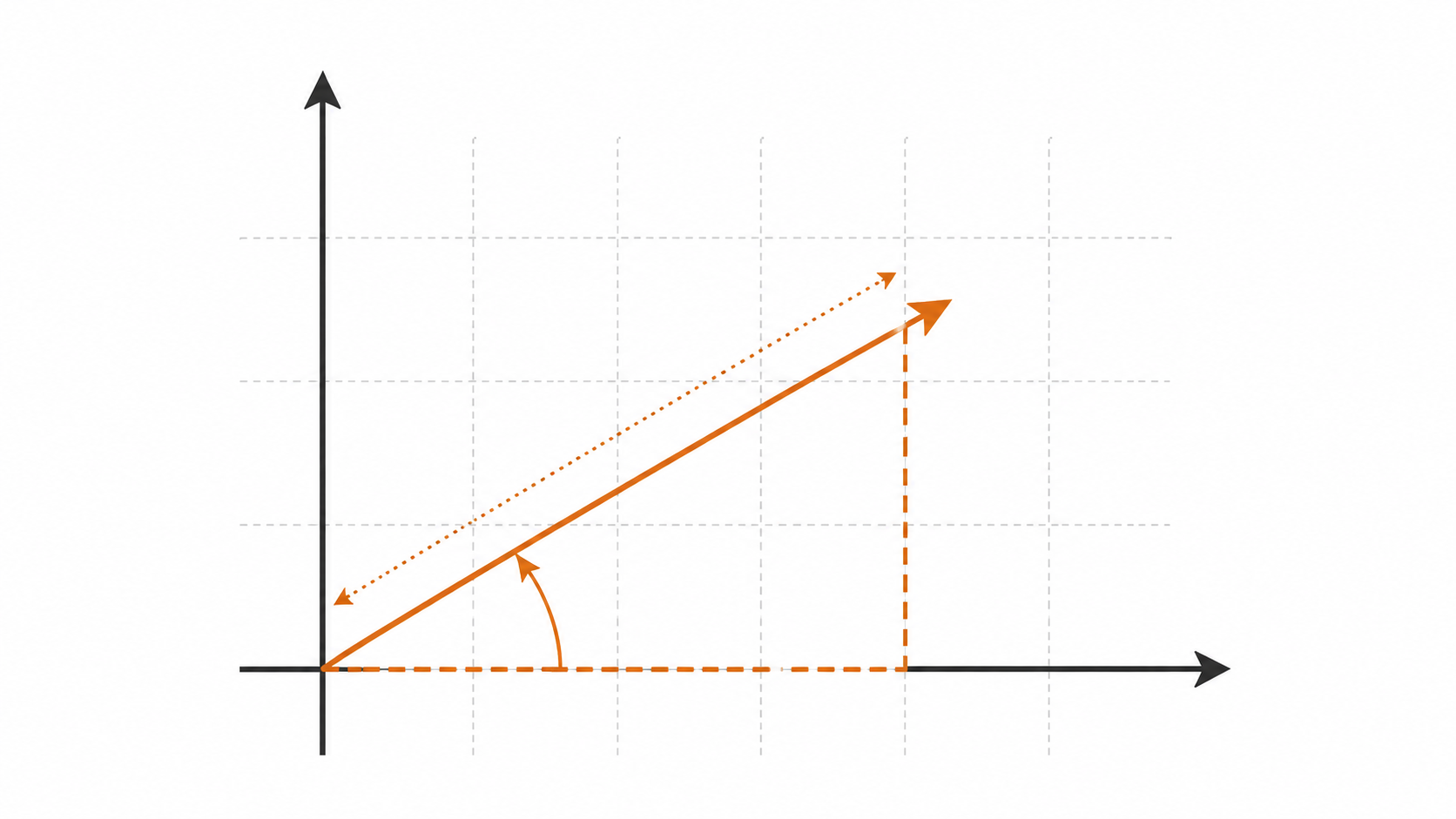
Velocity is a vector quantity that describes both how fast an object's position is changing and in which direction. The basic formula is v = d / t, where d is displacement (the straight-line distance from start point to end point, in a specific direction) and t is the time taken. The SI unit is meters per second (m/s), the same base units used throughout the International System of Units for rate quantities.
Because displacement is direction-sensitive, so is velocity. If you walk 5 meters east then 5 meters west over 10 seconds, your average speed is a healthy 1 m/s, since you covered 10 meters of ground. Your average velocity, on the other hand, works out to zero, because your displacement (net change in position) is nothing at all, you ended up back where you started.
Velocity vs. Speed: Why They're Not the Same
Speed and velocity are calculated with a similar-looking ratio, which is exactly what makes them easy to mix up. Speed is a scalar, distance divided by time, and it only ever answers "how fast." Velocity is a vector, displacement divided by time, and it answers "how fast, in which direction."
Same magnitude, different label: 60 km/h is a speed. 60 km/h north is a velocity.
Circular motion: a runner completing one full lap of a track covers real distance the whole way (positive speed throughout) but ends with zero displacement, so their average velocity for the lap is zero.
Two cars, same speed, different velocity: a car moving east at 60 km/h and one moving west at 60 km/h have identical speeds but opposite velocities.
That said, in practice, once direction is fixed and doesn't change (a car on a straight highway, for instance), speed and the magnitude of velocity turn out to be numerically identical, which is part of why the two terms get used interchangeably in casual conversation even though they aren't technically synonyms.
Average Velocity vs. Instantaneous Velocity
Real motion is rarely constant, a car speeds up, slows down, and stops at lights, so physics distinguishes between velocity measured over a whole trip and velocity at one specific moment.
Average Velocity
Average velocity is total displacement divided by total time for the entire trip, regardless of how the speed varied along the way. A road trip covering 240 km of displacement in 4 hours has an average velocity of 60 km/h, even if some of that driving was at 100 km/h and some was stopped at a rest stop.
Instantaneous Velocity
Instantaneous velocity is the velocity at one exact instant, mathematically the slope of the tangent line on a position-versus-time graph at that point. According to OpenStax University Physics, this is what a car's speedometer actually displays: not the trip average, but the velocity's magnitude at that precise moment.
What Negative Velocity Means
A negative velocity doesn't mean an object is doing anything unusual, it simply means it's moving in whichever direction has been labeled negative for that particular problem. If "east" is defined as positive on a number line, then a car moving west at 40 km/h has a velocity of -40 km/h, nothing more mysterious than a choice of reference direction.
This sign convention turns up constantly in freefall and projectile problems: an object thrown upward starts with a positive velocity, and as gravity acts on it, that velocity decreases, crosses zero at the peak of its arc, and turns negative on the way back down. Given that the direction convention is arbitrary, always check which direction a problem has defined as positive before interpreting a negative sign as "backward" or "wrong."
How Velocity Relates to Acceleration
Acceleration is the rate at which velocity itself changes, so the two are linked but not interchangeable, an object can have a large velocity and zero acceleration (steady speed in a straight line), or a small velocity and large acceleration (just starting to move quickly). Working out how an object's velocity is changing over time is exactly what our Magnitude of Acceleration Calculator handles, taking a change in velocity over a time interval and returning the acceleration driving it.
On top of that, velocity vectors don't just add up like plain numbers when more than one direction is involved, a plane flying north gets its ground velocity shifted by a crosswind blowing east, and the two combine geometrically rather than by simple addition.
Real-World Examples of Velocity
Escape velocity is one of the more striking real-world uses of the concept: it's the minimum velocity an object needs to break free of a planet's gravity without further propulsion. According to NASA, Earth's escape velocity is about 11.2 km/s, and the same formula, taken to its extreme, is what defines a black hole: pack enough mass into a small enough radius and the escape velocity exceeds the speed of light itself.
Closer to ground level, terminal velocity, the constant speed a falling object reaches once air resistance balances gravity, is another everyday example, relevant to anything from skydiving to raindrops. Our Terminal Velocity Calculator works out that balance point from an object's mass, drag coefficient, and cross-sectional area.
Meteorology, ballistics, and even GPS navigation systems all figure out velocity vectors constantly, since knowing an object's speed alone, without direction, isn't enough to predict where it will be a few seconds later.
Common Velocity Mistakes
Treating speed and velocity as always identical: they only match in magnitude when the direction of motion never changes, round trips and curved paths break the equivalence.
Confusing average velocity with average speed: a round trip has a real, nonzero average speed but an average velocity of exactly zero, since the net displacement is zero.
Adding velocities like plain numbers: when two velocities point in different directions, they need to be combined as vectors (component by component), not simply added together.
Reading a negative sign as "slowing down": a negative velocity signals direction, not deceleration, an object can have a large negative velocity and be moving very fast in the negative direction.
What I come back to most often when reviewing velocity problems is that nearly every error traces back to dropping the direction component somewhere along the way. Look into which direction was defined as positive before trusting any sign in the answer.
Frequently Asked Questions
What is the formula for velocity?
Velocity equals displacement divided by time: v = d / t. Displacement is the straight-line distance between the starting and ending position in a specific direction, not the total distance traveled along a path.
What is the difference between speed and velocity?
Speed is a scalar quantity that only measures how fast something is moving, while velocity is a vector quantity that measures both how fast and in what direction. A car traveling 80 km/h has a speed of 80 km/h, but only a velocity if a direction, like north, is also specified.
Can velocity be negative?
Yes, a negative velocity simply indicates motion in the direction defined as negative for that problem, not that an object is moving backward in any absolute sense. For example, if east is positive, an object moving west has a negative velocity even though it's still moving normally.
What is the difference between average and instantaneous velocity?
Average velocity is total displacement divided by total time over an entire trip, while instantaneous velocity is the velocity at one specific moment in time. A speedometer reading is an instantaneous velocity's magnitude, not the trip's average.
Can an object have zero velocity but nonzero speed?
Yes, this happens whenever an object returns to its starting point, such as completing a lap around a track. The total distance traveled is positive, so average speed is nonzero, but the net displacement is zero, making the average velocity exactly zero.
How is velocity used in real life?
Velocity is used anywhere direction matters as much as speed, GPS navigation, aircraft and ship heading calculations, ballistics, and orbital mechanics all rely on velocity vectors rather than plain speed. Escape velocity and terminal velocity are two specific applications used throughout aerospace and skydiving.