
Fractions vs. Decimals vs. Percentages: What's the Difference?
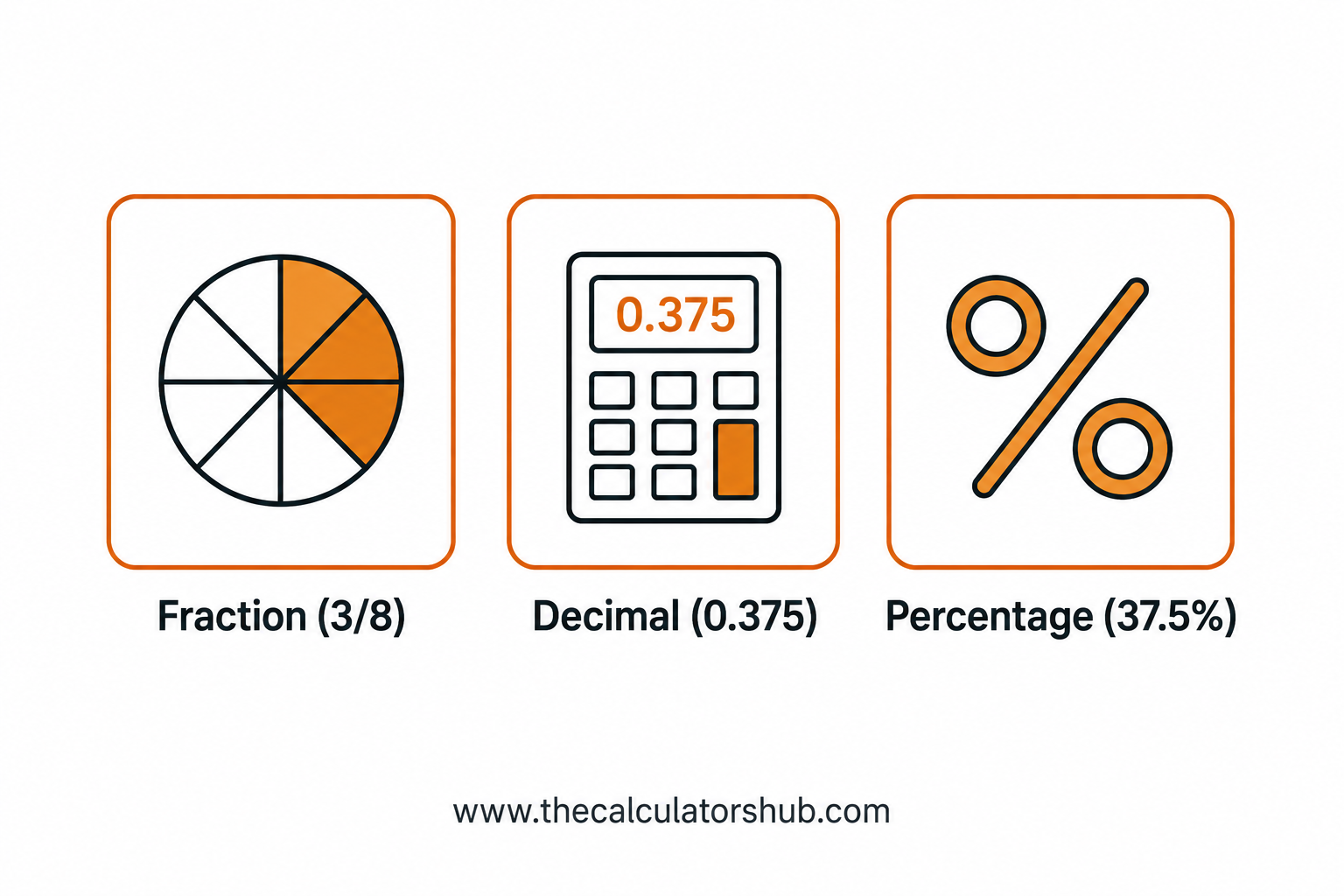
Quick answer: Fractions, decimals, and percentages are three different ways of writing the exact same value, 3/8, 0.375, and 37.5% all describe an identical amount. A fraction divides two whole numbers directly, a decimal expresses that division using place value, and a percentage is simply that decimal multiplied by 100 and labeled "out of a hundred," which is why converting between all three just comes down to division and moving a decimal point.
Fractions, decimals, and percentages get taught as three separate topics in school, but they're really one idea with three different notations layered on top of it. Knowing how to move between them isn't just a math-class skill, it's the difference between reading a recipe, a batting average, and a store discount fluently instead of having to stop and translate each one.
This post covers exactly how the three forms relate, how to convert between them in either direction, and what happens when a conversion, like 1 divided by 3, refuses to land on a clean number. If you just need the conversion done, our Decimal to Percent Converter and Percentage Calculator handle both directions instantly.
In this article:
Why Do Fractions, Decimals, and Percentages All Exist for the Same Thing?
A fraction is the most literal way to express a part of a whole, 3/8 simply means 3 parts out of a possible 8. A decimal takes that same division and carries it out using place value instead of a numerator and denominator, so 3/8 becomes 0.375. A percentage goes one step further and standardizes the denominator to exactly 100, according to Wikipedia's history of the term, which traces "percent" back to the Latin "per centum," or "by the hundred."
That standardization is the entire reason percentages exist: fixing the denominator at 100 makes any two percentages instantly comparable without needing a common denominator first, which a raw fraction comparison, say 3/8 against 5/13, doesn't offer without extra work.
Converting Between the Three Forms
Every conversion between the three forms comes down to the same handful of operations, worked out here with 3/8 as the running example.
Conversion | Method | Example |
|---|---|---|
Fraction → Decimal | Divide numerator by denominator | 3 ÷ 8 = 0.375 |
Decimal → Fraction | Use place value as denominator, then simplify | 0.375 = 375/1000 = 3/8 |
Fraction → Percentage | Divide, then × 100 | 3 ÷ 8 × 100 = 37.5% |
Percentage → Decimal | Divide by 100 (move decimal 2 places left) | 37.5% = 0.375 |
According to Math Is Fun's conversion reference, the fastest route between any two of the three forms almost always runs through the decimal in the middle, converting a fraction straight to a percentage without passing through its decimal form first is possible, but it's easy to make an arithmetic slip skipping that middle step.
The Repeating Decimal Problem
Not every fraction converts to a clean, terminating decimal. Take 1/3: dividing 1 by 3 gives 0.3333..., a 3 that repeats forever and never resolves to an exact stopping point. As a percentage, that becomes 33.333...%, properly written as the exact fraction 33⅓%, since no finite number of decimal digits captures the value precisely.
In everyday use, this gets rounded to 33.3%, which is accurate enough for most purposes but introduces a small, real error. Three people splitting a $10 bill evenly, each supposedly paying 33.33%, come out to $3.33 each, $9.99 total, a full cent short of the actual $10 because the rounding had to stop somewhere. That penny doesn't vanish, it's the visible fingerprint of a repeating decimal that got truncated to make the number usable.
Which Form Should You Actually Use?
Each form tends to win out in the context where it's genuinely the most natural, not arbitrarily. Recipes stick to fractions, a measuring cup is physically marked in ¼, ⅓, and ½ increments, not "0.75 cup" or "75%," because that's how the measuring tools themselves are built.
Sports statistics lean on decimals instead: a baseball batting average of .300 is always written as a decimal rather than 3/10 or 30%, specifically because decimals allow fine-grained ranking, .298 against .301 is instantly comparable in a way two awkward fractions wouldn't be.
Discounts, tips, and tax default to percentages because the fixed 100-denominator makes the math portable across any price without recalculating a ratio each time: a 20% discount on a $45 item comes out to $9 off no matter what the item costs, the same 20% figure applies cleanly everywhere. Professional bakers take this even further with what's called baker's percentage, expressing every ingredient as a percentage of the flour weight specifically because it lets a recipe scale up or down with simple multiplication instead of recalculating fraction-based ratios from scratch.
Common Conversion Mistakes
Forgetting to move the decimal point two places, not one, when converting between decimals and percentages. 0.375 is 37.5%, not 3.75%.
Rounding a repeating decimal too early in a multi-step calculation, which compounds a small error across every later step instead of carrying the full precision through until the final answer.
Comparing two fractions without a common denominator and guessing which is larger, 5/8 and 7/11 aren't obviously ordered until converted to decimals (0.625 versus 0.636) or a shared denominator.
Treating a percentage over 100% as an error when it's often correct, a value that's grown to one and a half times its original size is properly written as 150%, not capped at 100%.
Working through a couple of conversions by hand, rather than trusting a memorized shortcut, is usually enough to catch these before they turn into a wrong final answer.
Frequently Asked Questions
What is the difference between fractions, decimals, and percentages?
They're three notations for the same value: a fraction expresses a part of a whole directly (3/8), a decimal expresses that same value using place value (0.375), and a percentage standardizes it to a value out of 100 (37.5%). Converting between any two just requires division and moving a decimal point.
How do you convert a fraction to a decimal?
Divide the numerator by the denominator. For 3/8, that's 3 divided by 8, which comes out to 0.375.
Why do we use percentages instead of just fractions?
Percentages fix the denominator at exactly 100, which makes any two percentages instantly comparable without finding a common denominator first, something raw fractions like 3/8 and 5/13 don't offer without extra arithmetic.
What is 1/3 as a percentage?
1/3 as a percentage is 33.333...%, a repeating decimal that never fully terminates, commonly rounded to 33.3% or written exactly as 33⅓%. This rounding is why splitting something three ways "evenly" by percentage can leave a tiny leftover amount unaccounted for.
Is it a coincidence that some fractions equal exact decimals and percentages?
No, it comes down to the denominator: fractions whose denominator only has 2 and 5 as prime factors (like 8, which is 2³) always divide out to a terminating decimal, which is why 1/2, 1/4, and 3/8 land on exact values while 1/3 and 1/7 don't.
How do you convert a decimal to a fraction?
Write the decimal over a power of 10 matching its number of decimal places, then simplify. 0.375 has three decimal places, so it becomes 375/1000, which simplifies down to 3/8.
Why do sports statistics use decimals instead of percentages?
Decimals allow finer-grained ranking than percentages typically display, a batting average of .298 versus .301 is a meaningful, instantly comparable difference that would look identical or nearly identical if both were rounded to a whole-number percentage.