
What Is Momentum? Definition, Formula, and Examples

Quick answer: Momentum is the product of an object's mass and velocity (p = mv), a measure of how much motion an object has and how hard it would be to stop. A heavy truck moving slowly can have the same momentum as a small car moving fast, since momentum depends on both quantities together, not on either one alone.
Momentum is one of those physics terms that gets borrowed into everyday speech, "the team has momentum," "the deal lost momentum," in a way that captures the general idea but skips the actual math. In physics, momentum has a precise formula and a set of rules that don't always match the intuitive picture.
This guide sets out what momentum actually means, how it's calculated, how it differs from force and kinetic energy, and why it's conserved in ways those other quantities aren't. To calculate a specific object's momentum directly, our Momentum Calculator takes mass and velocity and returns the result instantly.
In this article:
What Momentum Means in Physics
Momentum (symbol p) is the product of an object's mass and its velocity: p = mv. Like velocity, it's a vector quantity, its direction is the same as the direction of motion, and it's measured in kilogram-meters per second (kg·m/s).
Because momentum depends on both mass and velocity together, two very different objects can carry the same amount of it. A 2,000 kg truck rolling at 2 m/s and a 40 kg cart rolling at 100 m/s both have a momentum of 4,000 kg·m/s, which is exactly why a slow-moving heavy vehicle can be just as hard to stop as a fast-moving light one.
Momentum vs. Force: What's the Difference
Momentum and force get confused constantly because Newton's second law connects them so tightly, but they measure different things. Force (F = ma) is what causes a change in motion, while momentum (p = mv) is a description of the motion an object already has. In its more general form, Newton's second law is written as F = Δp / Δt, force equals the rate of change of momentum, which is the formula that actually ties the two together.
That said, force isn't a conserved quantity the way momentum is. Given that force only exists while an interaction is happening (a push, a collision, a thrust), it makes sense to figure out an object's momentum before and after an event even when the forces involved during the event are complicated or unknown.
Conservation of Momentum
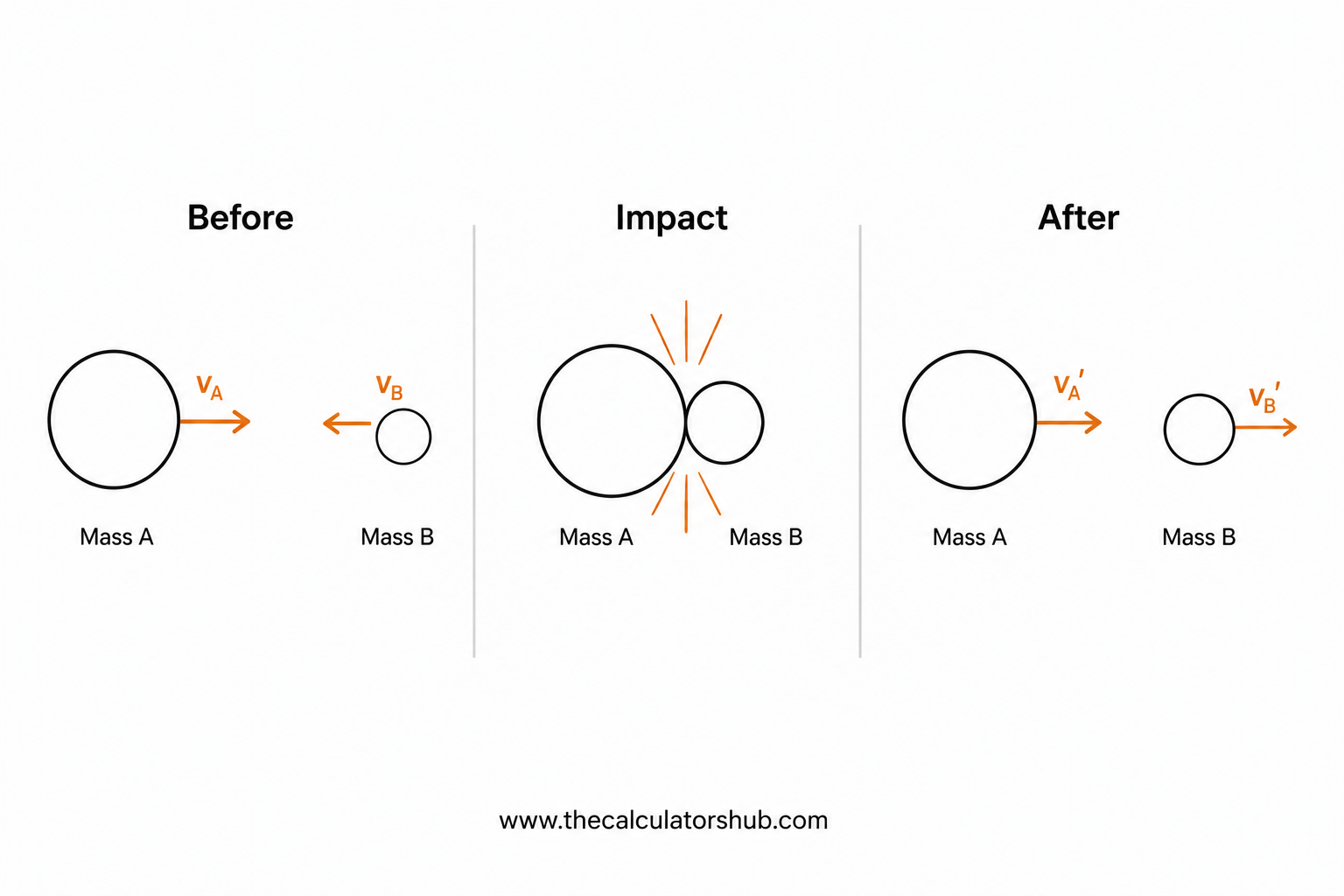
The law of conservation of momentum states that in a closed system with no external forces acting on it, the total momentum before an event equals the total momentum after it. If one object in the system gains momentum, something else in that same system loses exactly that much, internal forces between objects redistribute momentum but never create or destroy it.
A classic example is a cannon firing: the cannonball gains forward momentum, and the cannon itself picks up an equal and opposite momentum as recoil, working out to the same total as before the shot, which was zero. This is the same underlying rule that lets rocket engines work in the vacuum of space, where NASA explains that expelling exhaust mass backward gives the rocket forward momentum, with no need for anything external to push against.
Impulse and Momentum: How They're Connected
Impulse is force multiplied by the time it acts (J = FΔt), and it turns out to be mathematically identical to an object's change in momentum. This impulse-momentum relationship is what makes safety equipment work: the same change in momentum, say a car going from 20 m/s to a stop, can happen through a large force over a short time (hitting a wall) or a smaller force spread over a longer time (an airbag or crumple zone cushioning the same stop).
Working out how much force an impact will deliver, or how long a force needs to act to bring something to rest safely, is exactly what our Impulse and Momentum Calculator handles, taking a mass and a velocity change and returning the impulse required.
Elastic vs. Inelastic Collisions
Momentum is conserved in every collision, full stop, but what happens to kinetic energy during that same collision splits collisions into two categories.
Elastic Collisions
In an elastic collision, both momentum and kinetic energy are conserved, the objects bounce off each other without losing any energy to heat, sound, or deformation. Billiard balls striking each other come close to this ideal, and it's a useful approximation in gas particle physics.
Inelastic Collisions
In an inelastic collision, momentum is still conserved, but kinetic energy is not, some of it converts into heat, sound, or the physical deformation of the objects involved. A car crash where the two vehicles crumple and stick together is a textbook example, according to Physics LibreTexts, and it's precisely that lost kinetic energy, absorbed as crumple-zone deformation, that keeps passengers safer than a perfectly elastic impact would.
Why Momentum and Kinetic Energy Aren't the Same
Momentum (p = mv) and kinetic energy (KE = ½mv²) both depend on mass and velocity, but the velocity term is squared in one and not the other, and that single difference has real consequences. Doubling an object's velocity doubles its momentum but quadruples its kinetic energy, which is part of why a car crash at 80 km/h is dramatically more destructive than one at 40 km/h, not just twice as bad.
On top of that, momentum is always conserved in a closed system, while kinetic energy is only conserved in elastic collisions. A bullet fired from a gun carries the same momentum as the gun's recoil, in line with conservation of momentum, but the bullet carries far more kinetic energy than the gun does, since it has far more velocity concentrated into a much smaller mass.
Real-World Examples of Momentum
Rocket propulsion is one of the clearest large-scale demonstrations of momentum conservation: a rocket doesn't need air or ground to push against, it simply expels propellant mass in one direction to gain momentum in the other, which is why rockets work in the vacuum of space where wheels and propellers can't.
Vehicle safety engineering leans on the same principle from the other direction, spreading a large momentum change over more time (via crumple zones, airbags, and seatbelts) to reduce the peak force a passenger experiences. Working through how momentum redistributes between two colliding objects, such as a car striking a stationary object, is exactly what our Conservation of Momentum Calculator is built for.
Sports offer everyday examples too: a bowling ball's momentum is what knocks pins down, and a boxer "rolling with a punch" is deliberately increasing the time of impact to reduce the force delivered for the same change in the opponent's momentum.
Where People Go Wrong With Momentum
Treating momentum and force as interchangeable: force causes a change in momentum, but the two are measured in different units and aren't the same quantity.
Assuming kinetic energy is conserved in every collision: only elastic collisions conserve kinetic energy, momentum is conserved in all of them, elastic or not.
Forgetting momentum's direction: two objects moving toward each other have momenta that partially or fully cancel out, simply adding the magnitudes without accounting for direction gives the wrong total.
Mixing up momentum and impulse: impulse is the change in momentum caused by a force over time, not a separate, unrelated quantity.
What I come back to most often when reviewing momentum problems is that nearly every mistake traces back to dropping either the vector direction or mixing up which quantity is actually conserved. Narrow it down to those two checks and most errors disappear.
Frequently Asked Questions
What is the formula for momentum?
Momentum equals mass multiplied by velocity: p = mv. It's a vector quantity, so its direction matches the direction the object is moving in, and its units are kilogram-meters per second (kg·m/s).
What is the difference between momentum and force?
Force causes a change in momentum, while momentum describes the motion an object already has. Newton's second law connects the two directly: force equals the rate of change of momentum over time (F = Δp / Δt).
Is momentum always conserved?
Momentum is conserved in any closed system with no external forces acting on it, this holds true in both elastic and inelastic collisions. External forces, like friction from the ground or air resistance, can change a system's total momentum, which is why real-world momentum problems often specify a frictionless or idealized setup.
What is the difference between momentum and kinetic energy?
Momentum (p = mv) depends on velocity directly, while kinetic energy (KE = ½mv²) depends on velocity squared. As a result, doubling velocity only doubles momentum but quadruples kinetic energy, and momentum is always conserved in collisions while kinetic energy is only conserved in elastic ones.
Why do airbags reduce injury during a crash?
Airbags work by increasing the time over which a passenger's momentum changes to zero. Since impulse (force times time) equals the change in momentum, stretching that time out over a longer interval reduces the peak force the passenger's body experiences for the same overall change in momentum.
Can a small object have more momentum than a large one?
Yes, momentum depends on the product of mass and velocity, so a small, fast-moving object can carry more momentum than a large, slow one. A thrown baseball moving quickly can have comparable momentum to a much heavier object moving at a crawl, since it's the mass-velocity product that counts, not either quantity by itself.