
What Is the Heat Index? A Quick Guide to How It's Calculated

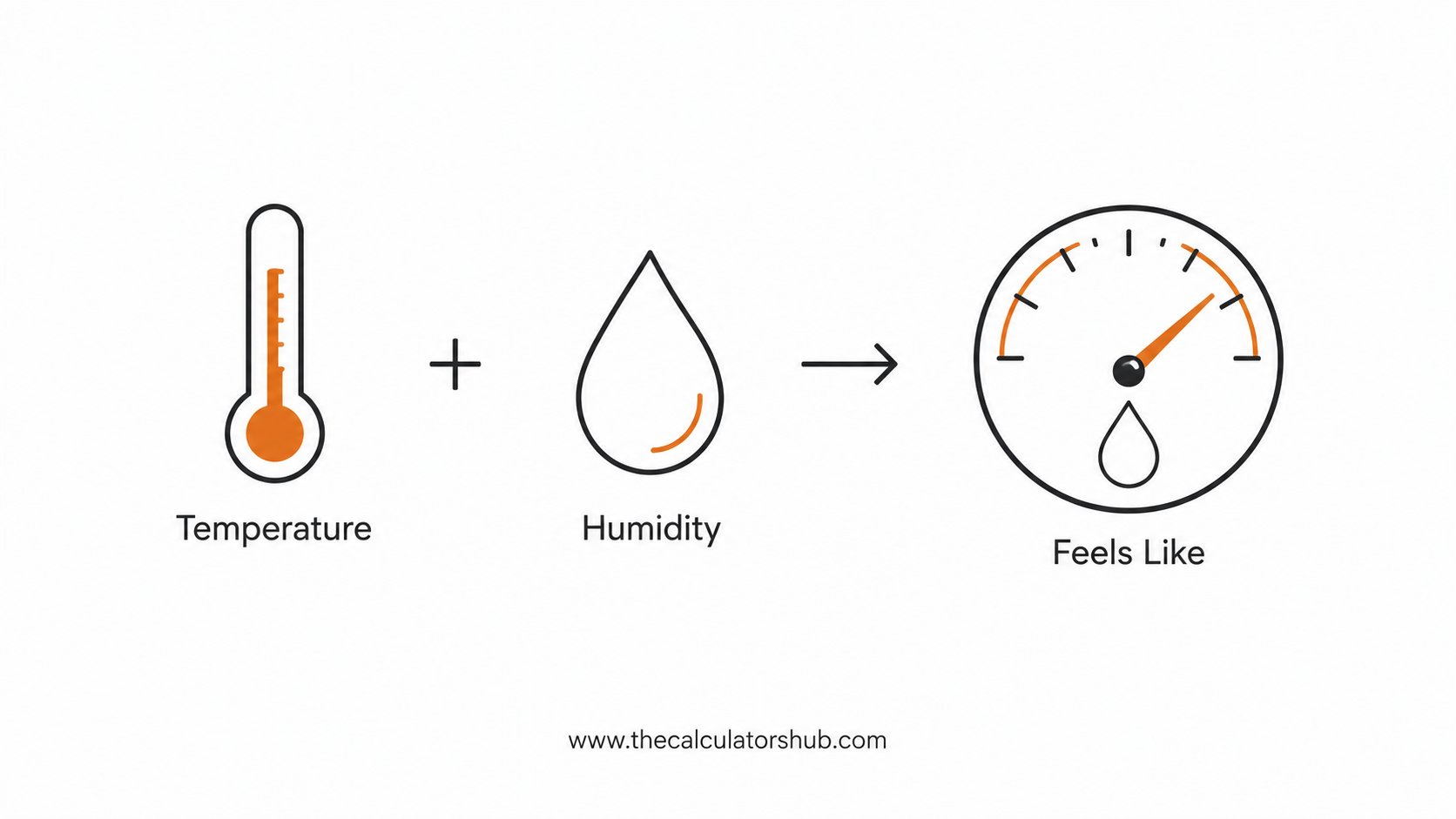
Quick answer: The heat index is the "feels like" temperature that combines air temperature and relative humidity into a single apparent-temperature value. At 90°F with 70% humidity, the heat index climbs to about 106°F, well into the National Weather Service's danger category, because high humidity slows sweat evaporation and makes the body's natural cooling system far less effective.
"It's not the heat, it's the humidity" isn't just a saying, it's a genuine physiological effect with a specific formula behind it. Two days at the exact same air temperature can feel completely different depending on how much moisture is already in the air.
This guide sets out how the heat index is actually calculated, why humidity changes how hot a given temperature feels, and how it compares to related terms like wind chill and "feels like" temperature. If you'd rather skip straight to a number, our Heat Index Calculator works it out from your local temperature and humidity.
In this article:
Why Humidity Makes Heat Feel Worse
The body's main cooling mechanism is evaporation, sweat pulls heat away from the skin as it evaporates into the air. When relative humidity is high, the surrounding air is already close to saturated with water vapor, so sweat evaporates far more slowly, and sometimes barely at all. The result is that the body's cooling system works less effectively even though the air temperature hasn't changed.
That's the entire mechanism behind the heat index: it isn't measuring a different temperature, it's estimating how hot the air actually feels once that reduced cooling efficiency is factored in.
The Heat Index Formula
The formula used by the National Weather Service is a regression equation developed by Lans P. Rothfusz in 1990, built from Steadman's earlier heat-stress research, combining air temperature (T, in °F) and relative humidity (RH, as a percentage) into a single apparent-temperature figure.
According to NOAA, the full Rothfusz regression only applies above 80°F and 40% relative humidity, a simpler formula is used below that threshold, since the humidity effect on perceived temperature is minimal at cooler, drier conditions.
Heat Index Danger Categories
The NWS groups heat index values into caution tiers rather than a single warning threshold, since risk increases progressively rather than at one sharp cutoff.
Heat Index Range | Category | Effect |
|---|---|---|
80°F - 90°F | Caution | Fatigue possible with prolonged exposure or activity |
91°F - 103°F | Extreme Caution | Heat cramps and heat exhaustion become possible |
104°F - 125°F | Danger | Heat exhaustion likely, heat stroke possible with continued exposure |
126°F and above | Extreme Danger | Heat stroke highly likely |
According to the CDC's heat health resources, more than 700 people die from extreme heat in the United States every year, with older adults, young children, and people with chronic medical conditions facing the highest risk.
Heat Index vs. Wind Chill vs. "Feels Like" Temperature
Heat index and wind chill measure opposite seasonal effects using the same basic idea, adjusting air temperature for a factor that changes how it actually feels. Heat index accounts for humidity in warm weather, wind chill accounts for wind speed stripping away the warm air layer around skin in cold weather. Neither applies outside its intended season, wind chill isn't calculated for hot days, and heat index isn't calculated for cold ones.
"Feels like" temperature is the broader umbrella term some forecasts use, it simply reports whichever of the two, heat index or wind chill, actually applies to current conditions, rather than being a separate calculation of its own.
Why Heat Index Underestimates Direct Sun
The official heat index formula assumes shade and light wind, conditions that rarely match a person standing in direct summer sun. In full sunshine, actual perceived heat can run 10 to 15°F higher than the published heat index value, since direct solar radiation adds a heating effect the formula doesn't account for at all.
Humidity itself is also worth tracking directly alongside heat index, since the dew point (the temperature at which air becomes saturated) is often a more stable indicator of how muggy conditions will actually feel than relative humidity alone. Our Dew Point Calculator works out that figure directly from temperature and humidity readings.
Real-World Uses of the Heat Index
Outdoor workers, athletic programs, and construction sites use heat index thresholds to trigger mandatory rest breaks and hydration schedules, since heat-related illness risk climbs sharply once the index crosses into the danger categories described above. School athletic associations in many regions use published heat index charts to decide whether outdoor practice needs to move indoors or be canceled outright.
Working out relative humidity directly from temperature and dew point readings, the input the heat index formula actually needs, is what our Humidity Calculator is built for.
Common Heat Index Mistakes
Ignoring the direct-sunlight adjustment: the published heat index assumes shade, actual conditions in full sun can feel 10 to 15°F hotter than the reported number.
Using the formula below 80°F or 40% humidity: the Rothfusz regression wasn't built for those conditions and produces unreliable results outside its valid range.
Confusing heat index with actual air temperature: the two numbers can differ by 15 to 20°F or more in humid conditions, treating them as interchangeable undersells real heat risk.
Applying wind chill logic to a hot, humid day: the two indices measure opposite effects and were never meant to be used together.
What I come back to most often when reviewing heat safety plans is that the danger-category chart is only as useful as remembering it assumes shade, not a person standing on open pavement at noon. Look into actual sun exposure before treating a published heat index number as the full picture.
Frequently Asked Questions
How is the heat index calculated?
The National Weather Service uses a regression formula developed by Lans Rothfusz in 1990, combining air temperature and relative humidity into a single apparent-temperature value. The full formula applies for temperatures at or above 80°F with relative humidity above 40%.
Why does humidity affect how hot it feels?
High humidity slows sweat evaporation, and since evaporation is the body's main cooling mechanism, less effective sweating means less effective cooling. This is why the same air temperature can feel dramatically hotter on a humid day than a dry one.
What's the difference between heat index and actual temperature?
Actual temperature is what a thermometer reads, while heat index is an estimate of how that temperature actually feels once humidity's effect on cooling is factored in. In humid conditions, heat index can run 15 to 25°F higher than the actual thermometer reading.
Is the heat index accurate in direct sunlight?
Not exactly, the official heat index formula assumes shade and light wind. In full direct sunlight, perceived heat can run 10 to 15°F higher than the calculated heat index value.
What heat index is considered dangerous?
The National Weather Service classifies 104°F to 125°F as the "Danger" category, where heat exhaustion is likely and heat stroke becomes possible with continued exposure. Above 126°F falls into "Extreme Danger," where heat stroke is highly likely.
What is the difference between heat index and wind chill?
Heat index adjusts air temperature for humidity's effect on perceived heat in warm weather, while wind chill adjusts air temperature for wind's effect on perceived cold. They measure opposite seasonal effects and are never calculated together for the same conditions.