
What Is BMI? A Simple Guide to the Formula and Healthy Ranges

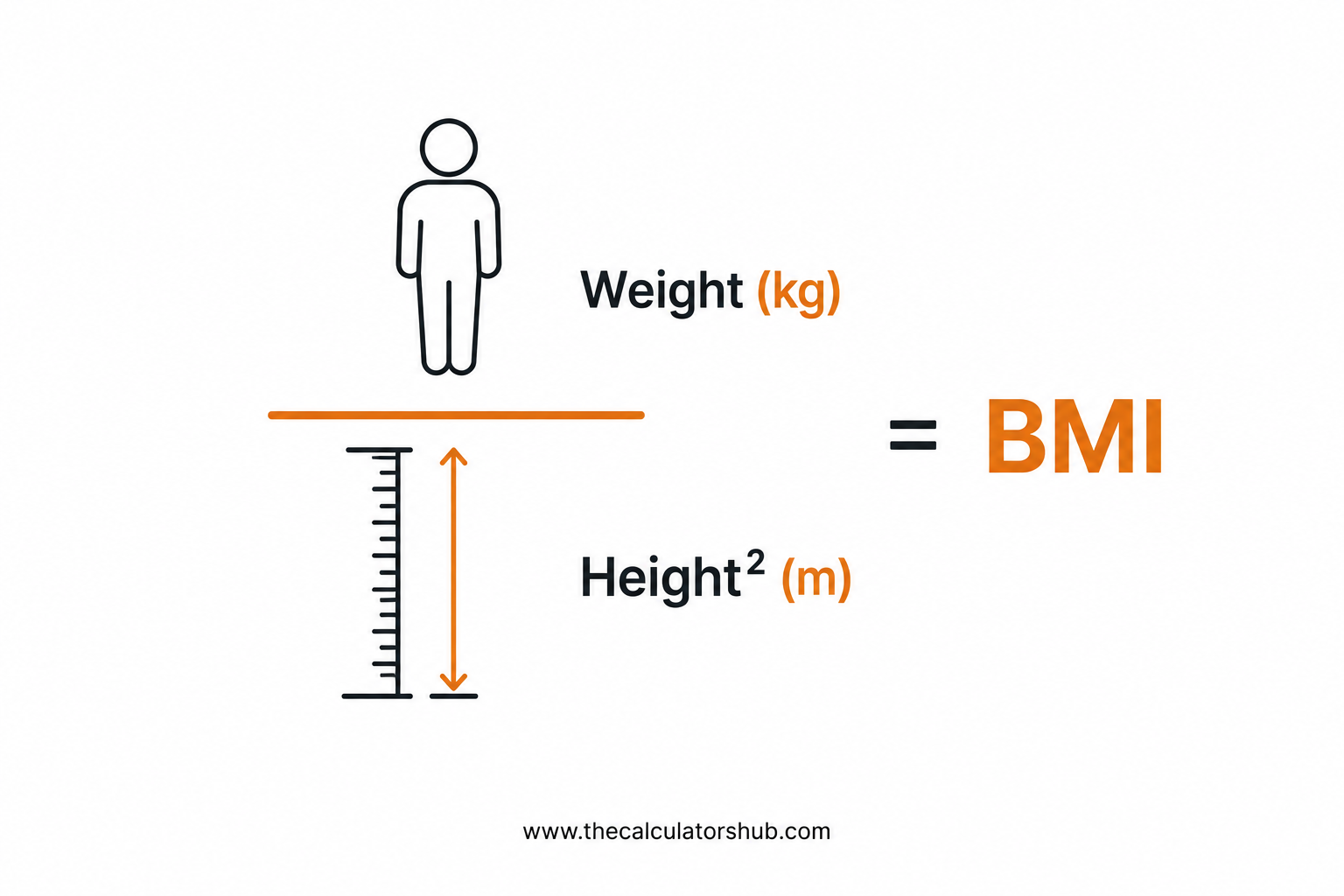
Quick answer: BMI (Body Mass Index) is calculated as weight in kilograms divided by height in meters squared (BMI = kg / m²), and a healthy adult range under WHO guidelines is 18.5 to 24.9. It's a quick screening number based on height and weight alone, not a direct measurement of body fat, which is exactly why it can misclassify very muscular people as overweight.
BMI shows up on medical intake forms, fitness apps, and insurance questionnaires so often that it's easy to assume it was engineered specifically to assess individual health. It wasn't, and that origin story explains a lot about where the formula holds up and where it doesn't.
This guide sets out how BMI is calculated, what the healthy-range categories actually mean, why muscle mass throws the number off, and where BMI is still genuinely useful despite its limitations. To check your own number against the standard categories, our BMI Calculator works it out instantly from height and weight.
In this article:
Where the BMI Formula Actually Came From
BMI started life as the "Quetelet Index," created in 1832 by Adolphe Quetelet, a Belgian mathematician and astronomer, not a physician. Quetelet was studying "the average man" as a statistical concept across large populations, and he noticed that adult body weight tends to scale with the square of height, which is where weight/height² comes from.
For roughly 140 years, the formula stayed a statistician's tool. It wasn't until 1972, when physiologist Ancel Keys and colleagues popularized it as a practical screening measure, that it became the individual-level health shorthand it's used as today, a use its original creator never intended or designed it for.
BMI Formula and How to Calculate It
The metric formula is BMI = weight (kg) / height (m)². In imperial units, it's BMI = weight (lb) × 703 / height (in)², the 703 constant exists purely to convert pounds and inches into the same kg/m² scale the metric version produces directly.
For example, a person weighing 70 kg at a height of 1.75 m has a BMI of 70 / (1.75 × 1.75), or 70 / 3.0625, which works out to roughly 22.9, comfortably inside the WHO-defined normal range.
BMI Categories and Healthy Ranges
According to the CDC's overview of BMI, adult BMI is interpreted using the same standard weight-status categories regardless of sex, age, or body type: under 18.5 is underweight, 18.5 to 24.9 is normal weight, 25.0 to 29.9 is overweight, and 30.0 and above is classed as obese. These thresholds were set by tracking the BMI levels at which chronic disease risk starts climbing across large population datasets.
These category boundaries also aren't universal across every country. Given that Asian populations tend to develop weight-related health risks at lower BMI values than the WHO's general thresholds, Japan defines obesity above 25 and China above 28, both notably stricter cutoffs than the standard 30 used elsewhere.
BMI for Children Uses Percentiles, Not Fixed Ranges
A fixed BMI number doesn't work the same way for children as it does for adults, since kids' body composition changes constantly as they grow. Instead of flat cutoffs, pediatric BMI is compared against a percentile chart for children of the same age and sex, a child in the 60th percentile has a BMI higher than 60% of their peers, which is a very different statement than a fixed "normal" or "overweight" label.
Working out where a child's BMI falls on that age-and-sex-adjusted curve, rather than against the flat adult thresholds, is exactly what our BMI Percentile Calculator is built for.
Why BMI Doesn't Tell the Whole Story
BMI is calculated from height and weight alone, which means it has no way to distinguish muscle mass from fat mass. A bodybuilder and a sedentary person of the same height and weight get an identical BMI, even though their body composition, and their actual health risk, can be dramatically different. This is a well-documented and widely acknowledged limitation, not a fringe criticism, according to NCBI, the metric consistently overestimates body fat in muscular, athletic individuals and can underestimate it in older adults who've lost muscle mass.
Getting a more direct read on body composition, rather than relying on height and weight alone, is what our BMI Body Fat Calculator is designed to add on top of the standard BMI number. This limitation is significant enough that the American Medical Association issued a 2023 policy recommendation urging physicians to treat BMI as one input among several, not a standalone diagnosis.
Real-World Uses of BMI
Despite its limitations, BMI remains genuinely useful at the population level, which is closer to what it was originally built for. According to WHO, more than 2.5 billion adults worldwide were classified as overweight in 2022, a statistic that depends on BMI as a consistent, low-cost, comparable measure across countries and decades. That kind of large-scale public health tracking is exactly the use case BMI was originally designed for.
At the individual level, BMI still functions well as a fast, free first-pass screening tool, flagging who might benefit from a more detailed assessment, rather than serving as a final diagnosis on its own.
Common BMI Mistakes
Treating BMI as a body fat measurement: it's calculated from height and weight only and cannot distinguish fat from muscle.
Applying adult BMI categories to children: pediatric BMI should always be read as an age-and-sex percentile, not against the fixed adult thresholds.
Using it as a standalone diagnosis: major medical bodies now recommend BMI be paired with other measures, like waist circumference or body composition, rather than used alone.
Ignoring population-specific thresholds: some countries use lower BMI cutoffs for obesity given documented differences in health risk at a given BMI across populations.
What I come back to most often when reviewing BMI numbers is that the formula was built to describe populations, not individuals, and forgetting that context is where most of the frustration with it comes from. Look into body composition specifically before treating a single BMI number as a complete health picture.
Frequently Asked Questions
What is a healthy BMI range?
For most adults, a BMI between 18.5 and 24.9 is classified as normal weight under WHO and CDC guidelines. Below 18.5 is underweight, 25.0 to 29.9 is overweight, and 30.0 or above is classed as obese.
How do you calculate BMI?
Divide weight in kilograms by height in meters squared: BMI = kg / m². In imperial units, multiply weight in pounds by 703, then divide by height in inches squared.
Why is BMI inaccurate for athletes and muscular people?
BMI is calculated from height and weight alone, with no way to tell whether that weight comes from muscle or fat. Since muscle is denser than fat, athletes and bodybuilders often get a BMI in the "overweight" or "obese" category despite having low body fat percentages.
Is BMI different for children than adults?
Yes, children's BMI is compared against percentile charts specific to their age and sex, rather than the fixed numeric ranges used for adults. A child's changing body composition during growth makes flat adult thresholds inappropriate.
Who invented BMI and why?
BMI was created in 1832 by Adolphe Quetelet, a Belgian statistician studying population averages, not individual health. It wasn't adopted as a medical screening tool until the 1970s, roughly 140 years after it was first developed.
Should I use BMI alone to judge my health?
No, major medical organizations, including the American Medical Association, recommend treating BMI as one screening input alongside other measures like waist circumference or body fat percentage, rather than a standalone diagnosis. It remains most reliable as a population-level tracking tool.