
What Is a Mole in Chemistry? A Simple Definition and How to Calculate It
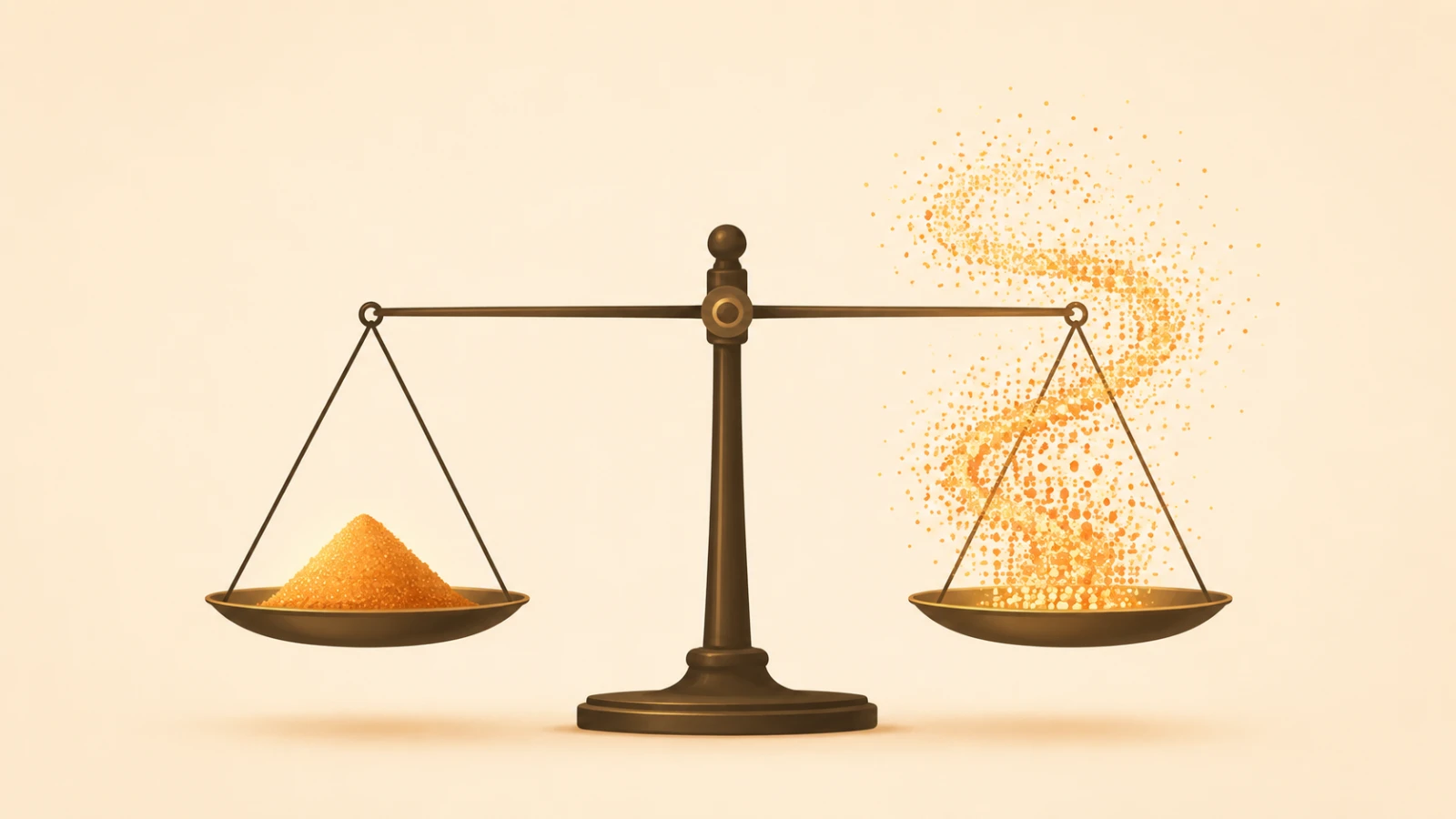
Quick answer: A mole is a counting unit equal to 6.022 × 10²³ particles, atoms, molecules, or ions, the same way "a dozen" always means 12 items regardless of what's being counted. Chemists use it because it's the specific number of particles found in exactly 12 grams of carbon-12, which lets a lab scale (measuring grams) stand in for a particle count no instrument could ever count directly.
Every unit of measurement solves a practical problem. "A dozen" solves the problem of talking about eggs without listing each one. The mole solves a much stranger problem: how do you count something you can never see individually, an atom, and connect that count to something you can actually weigh?
This guide sets out what a mole is, why the number is what it is, how to convert between grams and moles, and where the mole concept most often trips people up. If you just need the conversion done for a specific compound, our Mole Calculator handles grams, particles, and volume in one place.
In this article:
Why a Mole Equals 6.022 x 10²³
The number wasn't picked arbitrarily. It's defined as the number of atoms found in exactly 12 grams of carbon-12, a specific, stable isotope chosen as the reference point for atomic mass. According to Chemistry LibreTexts, that count, 6.02214076 × 10²³, is what's now called Avogadro's number, named after the Italian physicist Amedeo Avogadro even though he never measured it himself.
What makes this number genuinely useful is that it's the bridge between two completely different scales: the scale of individual atoms (far too small to weigh one at a time) and the scale of a laboratory balance (grams, which any bench scale can measure). Choosing this specific number means the molar mass of any element, in grams, comes out numerically equal to that element's atomic mass on the periodic table.
What a Mole Actually Measures
A mole (symbol mol) is the SI unit for "amount of substance," a counting unit exactly like a dozen or a gross, just at an astronomically larger scale. One mole of anything, carbon atoms, water molecules, or grains of sand, contains 6.022 × 10²³ of that thing.
What trips people up is that a mole is a count, not a mass or a volume. One mole of hydrogen atoms weighs about 1 gram, while one mole of lead atoms weighs about 207 grams, because each lead atom is far heavier than each hydrogen atom, even though both samples contain the exact same number of atoms.
How to Convert Grams to Moles
The formula is n = m / M, where n is moles, m is the mass of the sample in grams, and M is the molar mass of the substance in grams per mole. Finding M means adding up the atomic masses of every atom in the compound's formula, so sodium chloride (NaCl) has a molar mass of about 58.44 g/mol, sodium's 22.99 plus chlorine's 35.45.
For example, 5.00 g of NaCl divided by its 58.44 g/mol molar mass works out to 0.0856 mol. Running this conversion in either direction, grams to moles or moles to grams, is exactly what our Grams to Moles Calculator handles, once the compound's formula is entered.
Molar Mass vs. Molecular Weight
These two terms get used almost interchangeably, and for most practical lab purposes that's fine, but they aren't defined the same way. Molar mass is the mass of one mole of a substance, expressed in grams per mole (g/mol). Molecular weight (more precisely called relative molecular mass) is a unitless ratio comparing a molecule's mass to the atomic mass constant, expressed in daltons (Da).
Working out a compound's molar mass from its formula, which is the step that feeds directly into the grams-to-moles conversion above, is what our Molecular Weight Calculator is built for. Numerically, molar mass in g/mol and molecular weight in Da come out almost identical for any given compound, close enough that the distinction rarely matters outside of high-precision metrology.
The 2019 Redefinition of the Mole
For decades, the mole was defined by the carbon-12 standard described above, atoms in 12 grams. That changed on May 20, 2019, when the mole was redefined to be exactly 6.02214076 × 10²³ particles, full stop, rather than tied to a physical sample of carbon-12. According to NIST, this fixed Avogadro's number as an exact constant instead of a measured quantity, following years of international collaboration using silicon spheres to pin down the value to within 10 parts per billion.
In practice, the change is invisible to anyone doing routine lab chemistry, the number itself barely shifted. What it did was remove any dependence on a physical reference sample, putting the mole on the same conceptual footing as the meter and the second, defined by a fixed constant rather than a physical artifact.
Real-World Applications of the Mole
Baking is an unexpectedly good example: yeast fermentation converts glucose into ethanol and carbon dioxide in a fixed mole ratio, and that CO2 gas is exactly what makes bread dough rise. Industrial food production scales this same mole-ratio logic up from a kitchen recipe to a factory batch.
Pharmaceutical manufacturing depends on mole-based calculations to get drug doses and reaction yields precisely right, since even small stoichiometric errors compound across a large batch. Environmental scientists use moles per liter to report pollutant concentrations in water and air samples, the same underlying counting unit showing up in contexts as different as a bakery and a water treatment plant.
Common Mole Concept Mistakes
Treating the mole as a mass instead of a count: a mole is always 6.022 × 10²³ particles, but the mass that represents varies completely depending on what's being counted.
Misreading equation coefficients as grams: in a balanced chemical equation, coefficients represent mole ratios, not mass ratios, and mixing the two up throws off every downstream calculation.
Forgetting to balance the equation first: mole ratios pulled from an unbalanced equation are wrong before the stoichiometry calculation even starts.
Assuming equal masses mean equal moles: 10 g of hydrogen and 10 g of lead contain wildly different numbers of moles, since their atomic masses differ so much.
What I come back to most often when reviewing mole problems is that nearly every mistake traces back to forgetting the mole is a count, not a quantity of mass. Look into the molar mass conversion step specifically before trusting a downstream stoichiometry answer.
Frequently Asked Questions
What is a mole in simple terms?
A mole is a counting unit for extremely small particles, equal to 6.022 × 10²³ of whatever is being counted, atoms, molecules, or ions. It works the same way "a dozen" means 12, just at a vastly larger scale suited to counting atoms.
Why is Avogadro's number 6.022 x 10²³?
That number was originally defined as the number of atoms in exactly 12 grams of carbon-12, chosen because it makes an element's molar mass in grams numerically equal to its atomic mass on the periodic table. Since 2019, it's been fixed as an exact defining constant rather than tied to a physical carbon-12 sample.
How do you convert grams to moles?
Divide the mass in grams by the substance's molar mass in grams per mole: n = m / M. For example, 10 g of water (molar mass 18.02 g/mol) works out to 10 / 18.02, or about 0.555 moles.
What is the difference between molar mass and molecular weight?
Molar mass is the mass of one mole of a substance, in grams per mole. Molecular weight (relative molecular mass) is a unitless ratio expressed in daltons. The two are numerically almost identical for practical purposes, differing only at a level of precision that matters in metrology, not routine lab work.
Does one mole of every substance weigh the same?
No, one mole always contains the same number of particles, 6.022 × 10²³, but the mass of that mole depends entirely on the mass of each individual particle. One mole of hydrogen weighs about 1 gram, while one mole of lead weighs about 207 grams.
Why do chemists use moles instead of just weighing everything in grams?
Chemical reactions happen atom-to-atom and molecule-to-molecule, not gram-to-gram, so reaction ratios only make sense in terms of particle counts. Moles let chemists convert between a scale that can measure (grams) and the particle-count ratios a balanced equation actually describes.