
Related Expert Tools
More precision tools in the video-games niche.
Point Buy Calculator
The Point Buy Calculator helps tabletop RPG players, especially D&D 5e enthusiasts, allocate ability scores using the point buy system. This calculator instantly shows the point cost for each ability score from 8 to 15, ensuring balanced character creation within your campaign's budget constraints.
Elo Rating Calculator
The Elo Rating Calculator works out your expected score and rating change from a single game against a known opponent rating, using the standard chess and competitive gaming Elo formula. Its sequence mode tracks your rating game by game across a whole series, since each game's expected score depends on your rating at that point, not your starting rating. Use it to see why a 200-point rating gap isn't twice as significant as a 100-point gap.
Encounter Calculator 5e
The Encounter Calculator 5e rates a Dungeons & Dragons combat encounter as Easy, Medium, Hard, or Deadly using the 2014 Dungeon Master's Guide XP threshold and encounter multiplier rules. Enter your party size and level, then add monsters by challenge rating, and the calculator converts CR to XP automatically rather than requiring you to look it up separately. It adjusts the encounter multiplier for unusually small or large parties.
HP Calculator 5e Logic
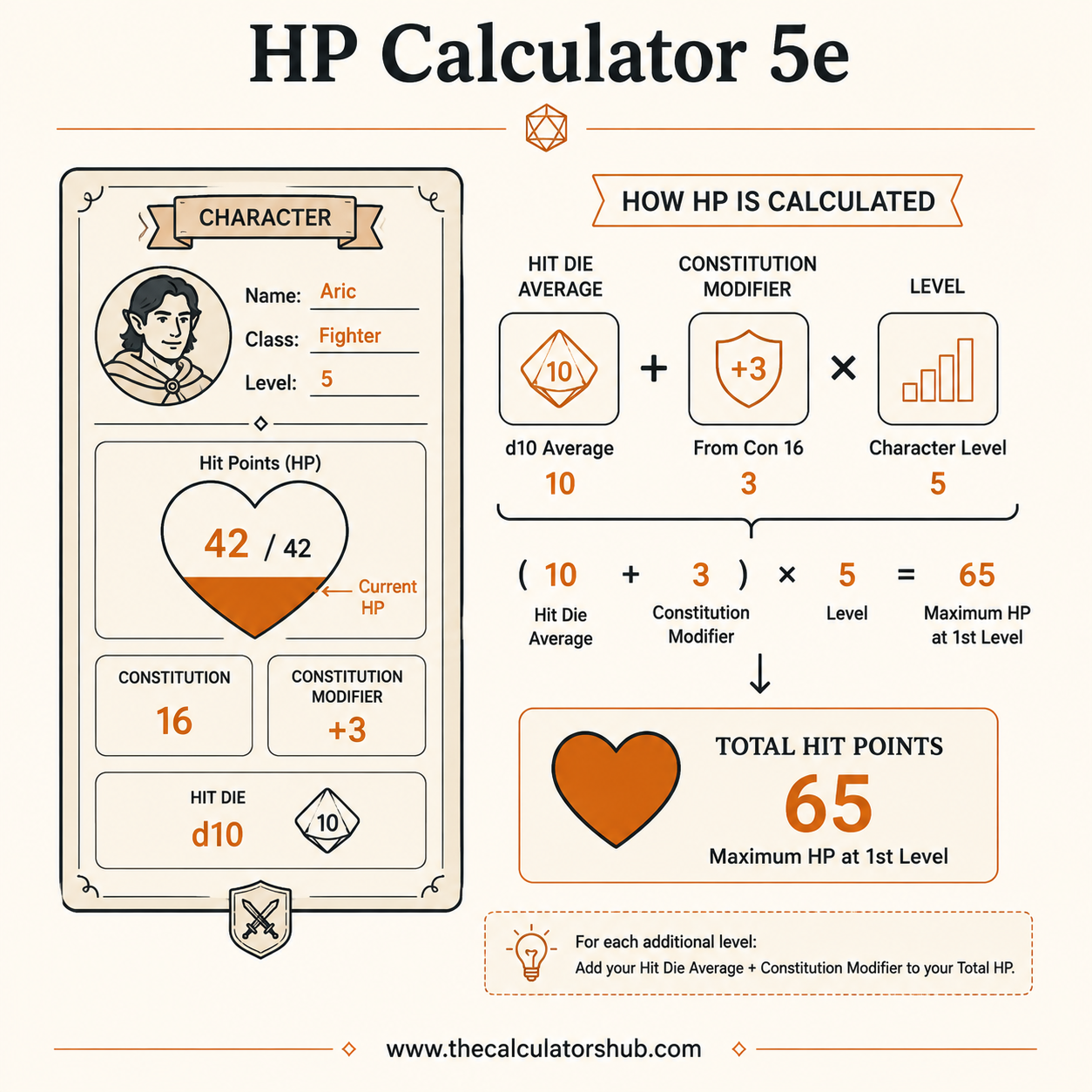
Level 1: max(hit die) + CON mod. Levels 2+: avg or rolled hit die + CON mod per level. Multiclass: sum per-class contributions.What Is the HP Calculator 5e?
The HP Calculator 5e computes a Dungeons & Dragons 5th Edition character's maximum hit points at any level, using the class's hit die, Constitution modifier, and choice of calculation method. Players and Dungeon Masters use it to check a character sheet, plan HP growth before levelling up, or verify an NPC's stat block against the official rules in the D&D Basic Rules character creation guide. It supports both single-class and multiclass characters, since HP calculation differs meaningfully between the two.
At first level, a character's maximum hit points equal the maximum value of their class's hit die plus their Constitution modifier, with no roll involved. Every level after that adds either a rolled or averaged hit die value plus the Constitution modifier again. Getting this sequencing right, maximum die at level 1 but a normal roll or average from level 2 onward, is the detail this calculator handles automatically. If you're checking whether that HP total is enough for what you're about to face, our Encounter Calculator 5e rates encounter difficulty against your party's level and size.
Hit Dice by Class
Each class has a fixed hit die that never changes, regardless of subclass, and it is the single biggest factor in how much HP a character accumulates over a campaign.
Hit Die | Classes |
|---|---|
d12 | Barbarian |
d10 | Fighter, Paladin, Ranger |
d8 | Artificer, Bard, Cleric, Druid, Monk, Rogue, Warlock |
d6 | Sorcerer, Wizard |
A level 10 Barbarian (d12) and a level 10 Wizard (d6) with identical Constitution scores differ by an average of 30 HP by that point, purely from the hit die difference, before accounting for the Barbarian's typically higher Constitution score on top of that. This is a deliberate design choice: front-line classes are built to absorb more damage than back-line spellcasters.
Average vs Rolled: Which Method to Use
The average method takes half the hit die value rounded up, plus one (so a d8 averages 5, a d10 averages 6), and applies that fixed number at every level after the first. The rolled method has the player roll the hit die at each level-up and use the actual result. Both are official rules; which one a table uses is a group decision, not a rules requirement either way, according to the D&D Basic Rules.
Rolling is more exciting at the table but carries real variance: a string of low rolls can leave a character with noticeably less HP than the average method would have given at the same level, and there is no official "reroll if below average" rule unless a table adds one as a house rule. Many Dungeon Masters running games for newer players default to the average method specifically to remove this swinginess and keep HP progression predictable for encounter balancing.
Average Maximum HP by Class and Level
Using the average method with a +2 Constitution modifier, a common starting bonus, HP totals diverge sharply by class as levels accumulate.
Class (Hit Die) | Level 1 | Level 5 | Level 10 |
|---|---|---|---|
Wizard (d6) | 8 | 28 | 58 |
Rogue (d8) | 10 | 38 | 78 |
Fighter (d10) | 12 | 48 | 98 |
Barbarian (d12) | 14 | 58 | 118 |
The gap between a Wizard and a Barbarian at the same level and Constitution score, 60 HP by level 10 in this example, is one of the clearest illustrations of how hit die choice compounds over a campaign, well beyond what the level-1 difference alone would suggest.
How Multiclassing Changes the Calculation
When a character takes levels in more than one class, hit points are tracked per class level, not per total character level. Each time a character gains a level in any class, they add that class's hit die (rolled or averaged) plus their Constitution modifier, using the hit die of the class the new level was taken in, not their original class. A Fighter 3 / Wizard 2 character has hit points built from three d10 rolls (or averages) and two d6 rolls (or averages), each with the Constitution modifier added separately, not five rolls of a single blended die.
The character's first class still determines the maximum-die-at-level-1 rule: only the very first level taken (in whichever class was chosen first) uses the maximum hit die value; every level after that, regardless of which class it is in, uses the rolled or average value for that class's die.
Accuracy and Limitations
This calculator applies the official 2014 rules exactly for the class, level, method, and Constitution modifier entered. It does not track HP lost to damage, temporary hit points, or class features that modify HP outside the standard formula (a small number of subclasses and feats grant bonus HP under specific conditions not covered by the base calculation, and should be added manually).
The Tough feat toggle adds a flat 2 HP per character level, applied retroactively at the level it is taken and thereafter, per the feat's text in the official Tough feat description. Other HP-modifying feats and features are not currently modelled and should be added to the calculator's result by hand. Once your character's ability scores and HP are both settled, our Point Buy Calculator handles the ability score allocation side of character creation.