
Related Expert Tools
More precision tools in the video-games niche.
Point Buy Calculator
The Point Buy Calculator helps tabletop RPG players, especially D&D 5e enthusiasts, allocate ability scores using the point buy system. This calculator instantly shows the point cost for each ability score from 8 to 15, ensuring balanced character creation within your campaign's budget constraints.
Elo Rating Calculator
The Elo Rating Calculator works out your expected score and rating change from a single game against a known opponent rating, using the standard chess and competitive gaming Elo formula. Its sequence mode tracks your rating game by game across a whole series, since each game's expected score depends on your rating at that point, not your starting rating. Use it to see why a 200-point rating gap isn't twice as significant as a 100-point gap.
HP Calculator 5e
The HP Calculator 5e works out a Dungeons & Dragons character's maximum hit points from class, level, and Constitution modifier, using either the fixed average method or manually entered rolls. It supports multiclass characters, applying each class's own hit die to the levels taken in that class. An optional Tough feat toggle adds the correct per-level bonus.
Encounter Calculator 5e Logic
Adjusted XP = (sum of monster XP by CR) x encounter multiplier; compare against party XP thresholds x party sizeWhy "Add Up the XP" Undersells or Oversells Most Encounters
The mistake I see most often from newer Dungeon Masters is comparing a monster's raw XP total directly against the party's XP threshold, skipping the encounter multiplier entirely. Three CR 3 monsters (700 XP each, 2,100 XP total) against a party with a 2,000 XP hard threshold looks survivable on paper. Once the multiplier for three to six monsters (x2) is applied, the adjusted XP is 4,200, which is deep into deadly territory for most parties.
The multiplier exists because a group of monsters is more dangerous than the same total XP concentrated in one creature: multiple attackers split the party's focus, flank more easily, and force more saving throws per round. Skipping the multiplier is the single most common way a DM's "should be fine" encounter turns into a near-TPK, exactly the scaling the official DMG encounter-building rules build the multiplier step around. Always let the calculator apply the multiplier rather than eyeballing raw XP totals against the threshold table, and once your party's hit points are set for the session, our HP Calculator 5e gives you the durability numbers to weigh against whatever difficulty rating this tool returns.
What the Encounter Calculator 5e Actually Does
This calculator works out D&D 5e encounter difficulty using the official Dungeon Master's Guide encounter-building method: it sums the party's XP thresholds for Easy, Medium, Hard, and Deadly based on level and party size, sums the monsters' XP by challenge rating, applies the encounter multiplier for monster count, and adjusts that multiplier for unusually small or large parties. Most online encounter calculators require you to already know each monster's XP value; this one converts challenge rating to XP automatically using the official CR-to-XP table, so you can add a monster straight from its stat block without a second lookup.
Dungeon Masters use this before a session to sanity-check a planned fight, or mid-session to gauge whether adding reinforcements will push an encounter past what the party can handle. It is a pre-fight planning tool, not a substitute for reading the room once dice start rolling.
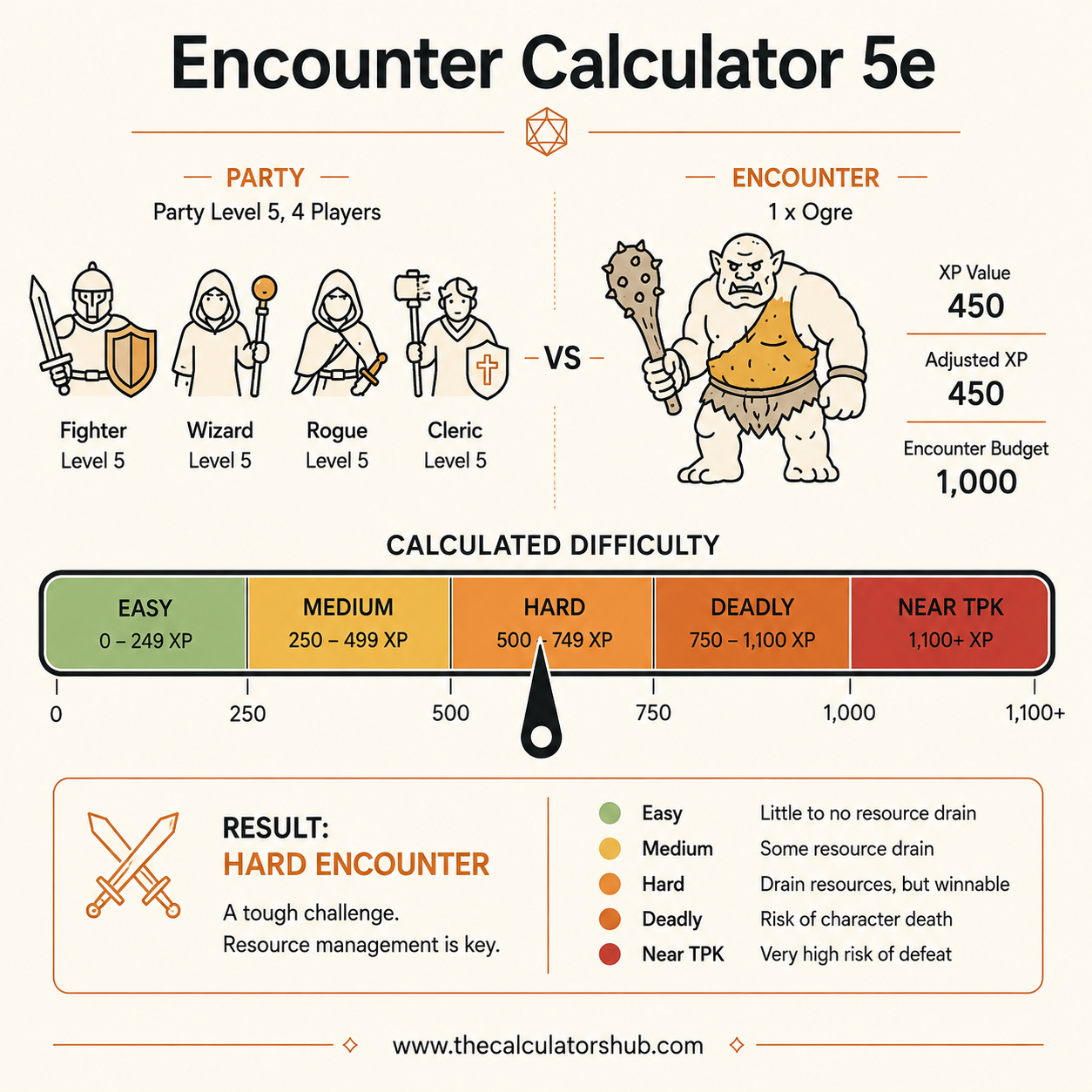
The XP Threshold and Encounter Multiplier Tables
Each character level has four XP thresholds, one per difficulty tier, and the party's total threshold is that value multiplied by party size. A single monster carries its full XP value toward the adjusted total; a group of monsters is scaled up because a mob a target faces at once is more dangerous per total-XP than one strong creature.
Number of Monsters | XP Multiplier |
|---|---|
1 | ×1 |
2 | ×1.5 |
3–6 | ×2 |
7–10 | ×2.5 |
11–14 | ×3 |
15+ | ×4 |
If the party has fewer than three players, the calculator shifts one row up the table (making the same monster count feel more dangerous, since there are fewer targets to spread attacks across). If the party has six or more players, it shifts one row down. This adjustment is easy to forget when calculating by hand and is one of the more common sources of a miscalculated difficulty rating, a rule the Roll20 D&D 5e combat compendium lists alongside the full threshold-by-level tables for quick reference at the table.
Challenge Rating to XP: Why This Matters More Than It Seems
Challenge rating itself is not a linear scale, and CR-to-XP conversion is not linear either. A CR 5 monster is worth 1,800 XP, but a CR 10 monster is worth 5,900 XP, more than three times as much, not double. This is because higher-CR monsters typically deal disproportionately more damage and have more ways to threaten multiple party members per round, so their XP value reflects that non-linear escalation in danger. According to the D&D Beyond Monster Manual index, every published monster's stat block lists its CR and XP value together for exactly this reason: they are not meant to be derived from each other by simple multiplication.
Homebrew or reflavored monsters without a listed CR should be assigned the CR of the closest official monster with similar hit points, AC, attack bonus, and damage per round, since guessing an XP value directly tends to be far less accurate than working from an existing statistically similar creature.
A Worked Example Across Party Sizes
The same monster group plays out very differently depending on party size, which is easy to underestimate when reusing an encounter between two different groups. Four CR 4 monsters (1,100 XP each, 4,400 XP raw total) against a level 5 party fall under the x2 multiplier for three to six monsters, giving an adjusted XP of 8,800.
Party Size (Level 5) | Hard Threshold | Deadly Threshold | Rating for 8,800 Adjusted XP |
|---|---|---|---|
3 players | 2,250 | 3,300 | Deadly (multiplier shifted up one row) |
4 players | 3,000 | 4,400 | Deadly |
6 players | 4,500 | 6,600 | Deadly (multiplier shifted down one row) |
Even with the multiplier shifting in the larger party's favour, this particular group of monsters stays deadly across every party size in the table, a scaling pattern the 2024 revised Dungeon Master's Guide preserves in its own simplified party-size scaling even though it drops the separate multiplier step, which is exactly the kind of check worth running before reusing a favourite encounter with a differently sized group. If you're building the characters themselves rather than just the encounter, our Point Buy Calculator handles ability score allocation for a new party.
Accuracy and Limitations
This calculator's math matches the official 2014 DMG method exactly for the inputs given: party size, party level, and monster CR. It does not model encounter-specific factors the DMG explicitly leaves to DM judgement, such as terrain, whether the party gets a surprise round, environmental hazards, or a monster's specific tactics (a pack of wolves that focuses fire on one target plays very differently from the same wolves spread thin, even at identical XP).
The 2024 revised Dungeon Master's Guide replaced this XP-threshold-and-multiplier system with a simpler combat-budget method that doesn't use a separate multiplier step. If your table has switched to the 2024 rules, treat this calculator's output as a 2014-rules reference rather than a literal match to your DM's guide.